Black Pool Ideas: Dramatic Looks, Real Heat and Upkeep
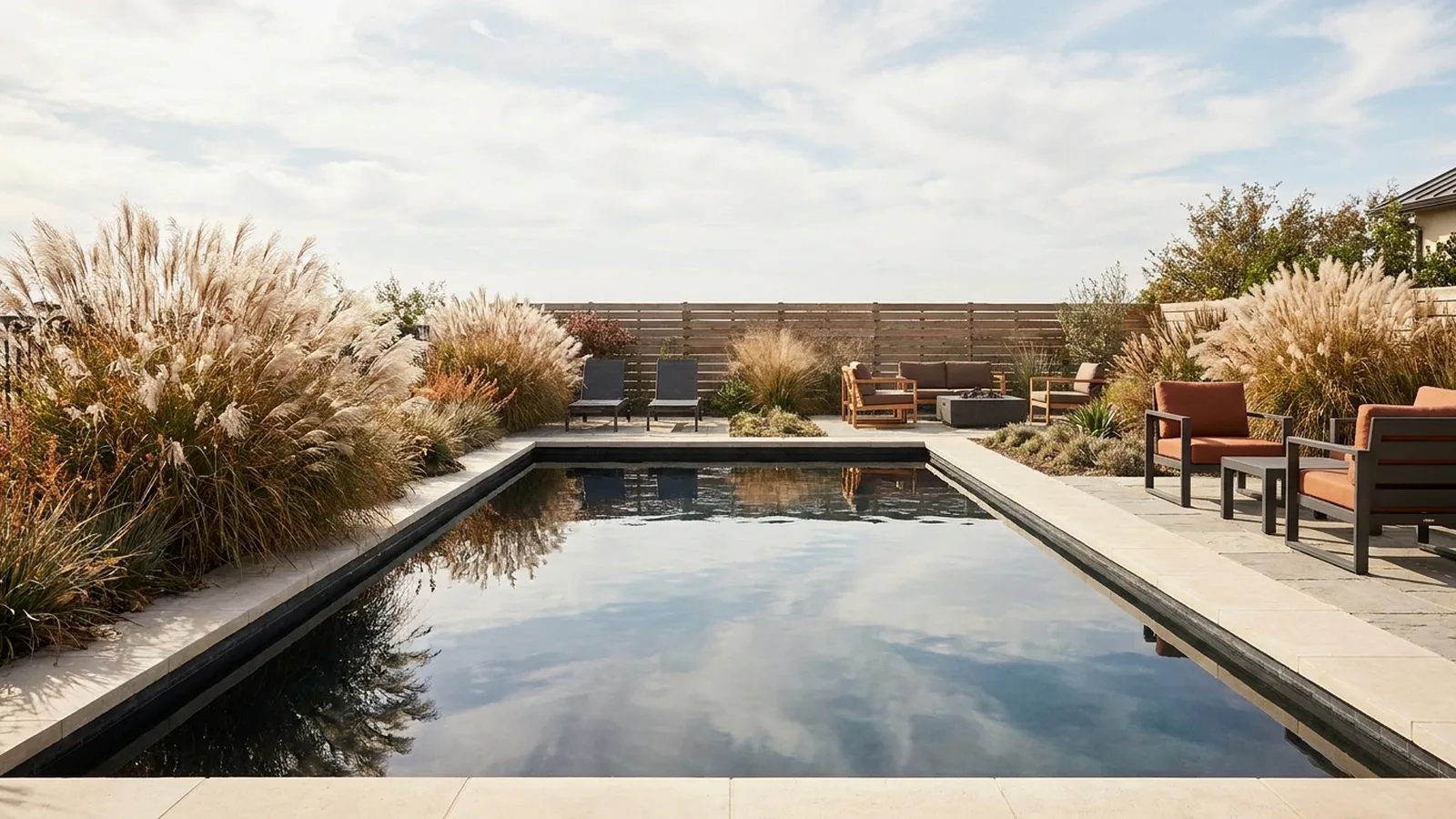
Say you’re standing at the edge of a half-dug backyard, holding two finish samples. One is classic pale blue. The other is an inky charcoal that turns into a mirror when the sun hits it. Your contractor shrugs and says, "Either one works." Your eyes say the dark one. Your wallet says it might not be that simple.
Your wallet has a point. A black pool is one of the most photographed backyard looks right now, and one of the most argued about in pool forums. Some owners call it the best decision they ever made. Others replaster within a few years, annoyed that it faded to a splotchy grey.
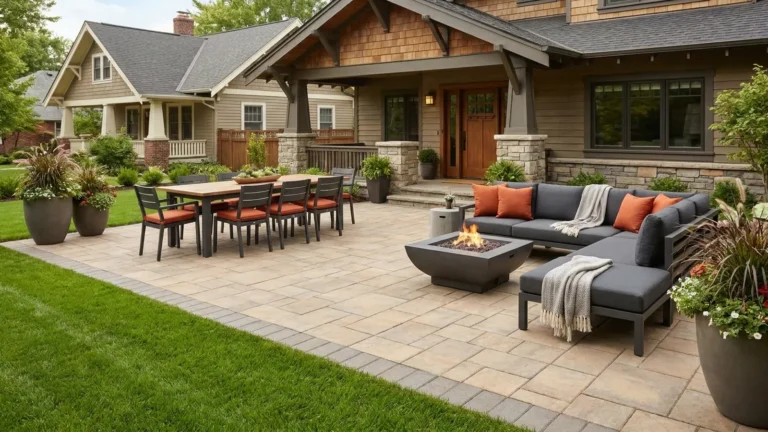
This guide gives you the full picture before you commit: which finishes stay dark, how hot the water really gets, what it costs, and how to keep swimmers safe. It’s one part of planning your outdoor space, so if you’re still shaping the whole yard, start with these patio design ideas that make a backyard feel finished.
Executive Summary
A dark pool can look spectacular, but the look depends on the material you pick, not the color name on the sample. Black plaster is the riskiest choice because it tends to fade, mottle and show every flaw. Dark pebble, glass tile and good liners hold color far better, though they cost more up front.
You’ll learn what a black pool really means (it isn’t a hot tub or a seaside town), why the heat-gain claim is oversold, and why a pool cover beats color every time. You’ll also get a safety checklist for families, a weekly upkeep routine, a way to test colors in real water, and dark-but-not-black shades that give you most of the drama with fewer regrets.
The big objection is "won’t it just turn grey?" Sometimes, yes. With the right finish and good water care, the answer changes, and this guide shows you exactly how to choose before any concrete is poured.
What does "black pool" actually mean?
A black pool is a swimming pool with a black or very dark interior, such as black plaster, dark pebble, black tile, a charcoal liner or a dark fiberglass shell. The water itself isn’t black. It looks deep and mirror-like because the dark surface absorbs light instead of bouncing it back up.
Search the phrase and you’ll mostly find an English seaside town, a film, a Yellowstone hot spring and a countertop color. None of those help you pick a finish. Pool people call yours a "black bottom" pool, and the slang includes onyx, midnight and charcoal.
Four families cover nearly every option. Dark plaster is cement with pigment, cheapest but least stable. Dark pebble or quartz is small stones set in cement, so color lives in the stone. Tile or glass mosaic is hand-set and the most durable. Liners and fiberglass shells are smooth, replaceable skins in charcoal or black.
Which family you choose matters far more than the word "black." Keep that in mind, because it comes up in every section below.
Does a dark pool really heat up faster?
A black pool can absorb a little more sun, so the water may feel slightly warmer on a bright day. The effect is smaller than most people expect and hard to measure. A cover, shade, wind and your heater settings change water temperature far more than the color of the bottom does.
Owners of a black pool tell a consistent story. One says the water is warmer and loves it. A contractor in the same thread calls the heat gain negligible. A Quora answerer says a dark pool in full sun is warmer but you may not notice, and with a cover on, color becomes almost insignificant. Trouble Free Pool members say darker finishes hold more heat. A small, real, hard-to-measure effect.
No source I found gives a degrees-Fahrenheit number measured under controlled conditions, so think about your yard instead.
| Your situation | Does dark help? | What matters more |
|---|---|---|
| Spring and fall swims | A little | Solar cover, heater, wind |
| Peak summer, full sun | Barely noticeable | Shade, cover at night |
| Hot climate, full sun | May feel too warm | Shade sail, lighter dark shade |
The surroundings count too. A black pool beside dark decking stacks heat under bare feet. A lighter tone, like those in our guide to choosing a deck stain that stays cool and looks good, keeps the whole area comfortable.
Which black pool finish lasts longest?
Glass tile lasts longest and holds color best, then dark pebble, then liners and fiberglass, with black plaster last. Plaster fades and mottles because pigment sits in cement paste that reacts to chemicals and sun. Stone and glass carry their color inside the material itself.
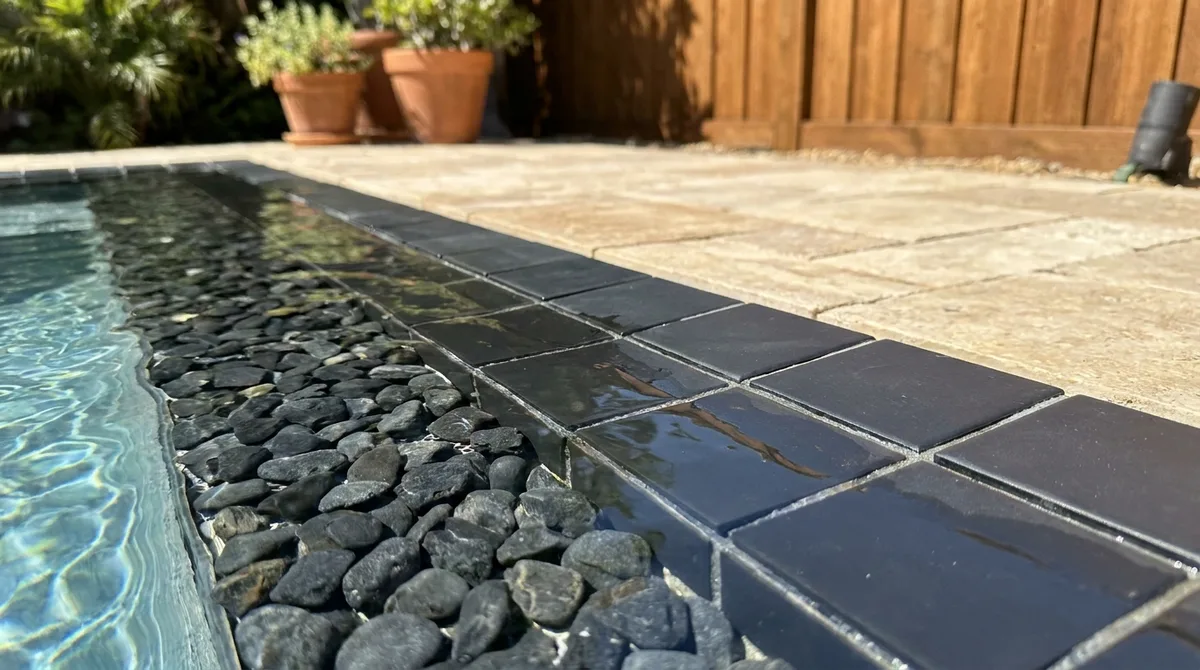
This is the most important decision in the project, so let’s go slowly. Contractor sources quote ballpark lifespans of about 5 to 10 years for plaster, 10 to 20 for pebble and 20 to 50 or more for tile. Treat those as rough, since water care, climate and workmanship change them.
Black plaster is the risky one. Stanton and other finish specialists note that darker plaster fades and mottles faster than lighter shades. One contractor in an r/pools thread said their company won’t go darker than French grey in plaster, even with perfect chemistry. Another said every black plaster pool ends up looking like the moon: splotchy and uneven. Any trowel mark or scale patch shows as a pale cloud on a dark background.
Dark pebble is the sweet spot. Finishes such as Pebble Tec or Diamond Brite’s Onyx-style blends use stones or quartz, so the color is in the aggregate. Blue Haven suggests dark pebble commonly lasts 15 to 20 years, and it hides small flaws better. My opinion: if you want true black and refuse to compromise, price pebble first.
Tile and glass mosaic cost the most and last the longest, and they never etch like cement. Many owners use a hybrid with tile at the waterline and steps and pebble on the floor. Liners and fiberglass are simple and smooth, though a liner wears over time and a fiberglass gelcoat limits you to the manufacturer’s color list.
How much does a black pool cost compared with a white one?
Expect a black pool to cost more than a white one, mainly because the durable dark finishes are premium materials. Pebble often runs double or triple the price of plaster, and tile costs more again. Size, region, old surface condition and contractor change the final number.
I can’t quote a real "black premium," because no source I found measured one. What I can do is show how the pieces stack. Aiper, citing Angi, puts plaster near $4 per square foot with roughly a 10-year life, and pebble near $10 with 20-plus years. Blue Haven says pebble can cost double or triple plaster. Use these rough national figures to compare finishes, not to budget.
Real quotes swing widely. In one r/pools replaster thread, an owner was quoted $15,885 for a 15 to 17k gallon pool and spa, while replies mentioned $3,000 through a subcontractor on 10,000 gallons. Those are anecdotes, but commenters also warned to expect about 10 percent extra once old plaster is opened up.
The honest math is lifespan, not sticker price. A cheap finish replaced twice can cost more over 20 years than pebble installed once. Ask for quotes on two finishes and ask what the color looks like at year five.
Why does black plaster fade, and can you prevent it?
Black plaster fades because the cement paste around the pigment slowly changes. Calcium deposits, aggressive water, uneven curing and sun all lighten or cloud the surface. You can slow it with careful water balance and a proper startup, but you can’t fully prevent it.
Think of dark plaster as a black t-shirt that reacts to everything in the wash. Chemistry drift a white pool hides shows up as a pale haze.
A common version of this mistake goes like this. A homeowner picks charcoal plaster, the pool fills fast, and the water runs low in calcium. The surface etches slightly, meaning the water dissolves a little cement at the top. Within months the floor looks chalky and grey, and the fix is a new surface.
What protects any dark finish:
- Follow the curing and startup steps exactly. Ask your builder for them in writing.
- Keep water balanced. Pros use the Langelier Saturation Index (LSI) to check whether water will dissolve or deposit minerals.
- Brush gently so scale doesn’t form white speckles.
- Ask your pro before any acid wash. Harsh treatments on a dark surface are a decision for a specialist, not a weekend experiment.
- Vet the installer. Trowel marks and uneven finishing are a common source of workmanship disputes, and dark colors expose them.
Is a black pool safe for kids and swimmers?
A black pool can be safe, but it needs deliberate design. Dark water makes depth, steps and anyone below the surface harder to see. Add contrasting edges, marked steps and benches, bright lighting and strict supervision. Barrier and permit rules still apply and vary by location.
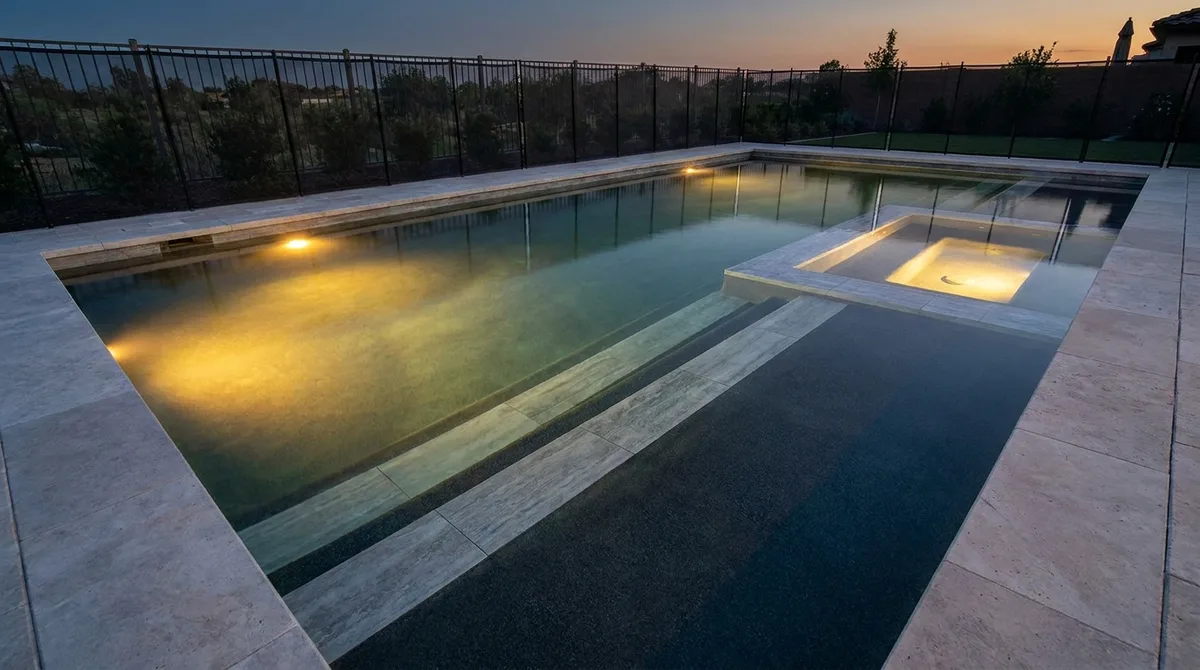
In dark water the bottom is harder to read from above, and a child below the surface is harder to spot than in pale blue water. Some owners in pool forums raise this worry about dark pebble. It doesn’t mean skipping the look. It means planning for it, with a licensed pool builder handling excavation, electrical lighting and barrier work.
The family safety checklist:
- Contrast the edges with a lighter tile band or coping.
- Mark every depth change. Steps, ledges and benches get a lighter shade.
- Light the water well, more than a pale pool needs, so you can see the whole floor at night.
- Assign a watcher. Never rely on seeing through the water.
- Check local barrier rules for fences, gates, covers and alarms before you design.
One more opinion. With toddlers or a nervous swimmer in the house, dark grey or deep blue is a smarter compromise than true black. Some Quora answerers say kids are put off by a very dark pool anyway.
Does a dark pool show dirt, and what does upkeep look like?
A black pool shows leaves, bugs and pale debris clearly but can hide fine silt, dark algae and early scale. You can see what needs skimming, yet miss slow chemistry problems. Most owners run a robotic cleaner daily, test water weekly and use a cover.
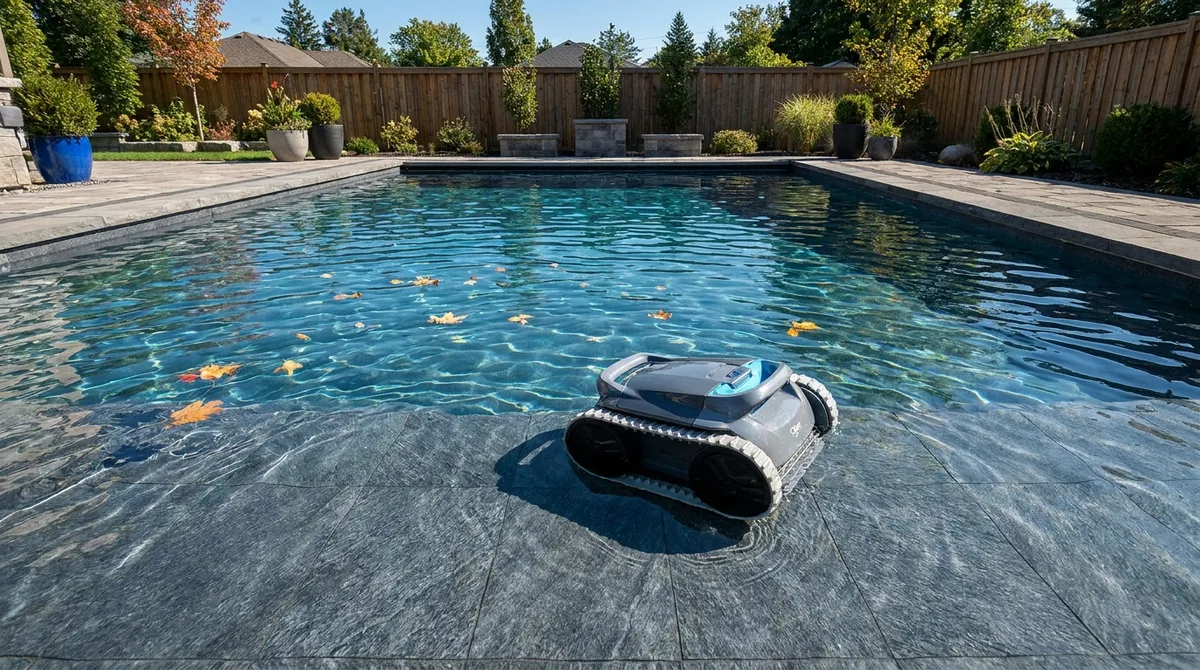
People assume black hides dirt, like a black car. Think black kitchen counter instead: every crumb shows. Leaves and pollen sit on top like confetti. One r/pools owner said debris is hard to see on the floor and that a robotic cleaner runs daily.
My contrarian take: a black pool is easier to judge for leaf cleanup, since the problem is obvious. The real risk is chemistry, and your eyes won’t catch that.
Say a typical week looks like this (a hypothetical routine, not a measured one). Skim daily or as needed. Let the robotic cleaner run daily or every other day. Test and balance water weekly. Brush gently once a week to stop scale. Empty skimmer and pump baskets weekly. Cover the pool when idle. Check with a pro each season. Ask your builder whether your finish suits a saltwater system.
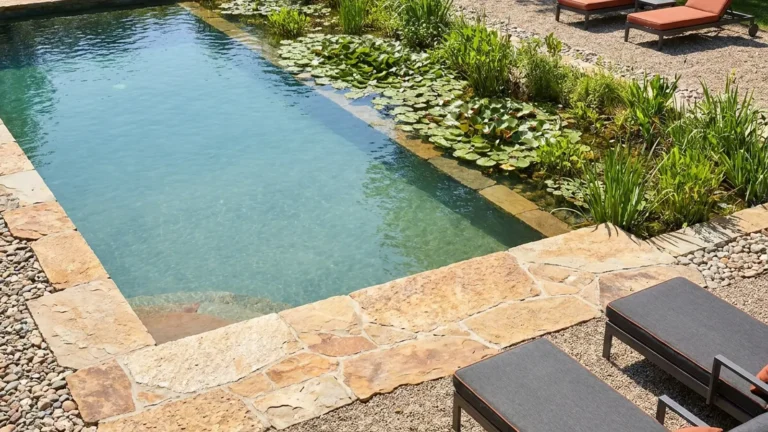
If you’d like fewer chemicals overall, see how a natural pool handles filtering and clarity.
Which dark pool styles look best?
The best styles use the dark surface as a mirror: a plunge pool with a dark floor, an infinity edge facing a view, a tile waterline over a pebble floor, or a minimal rectangle with warm night lighting. Pair the water with pale stone, simple planting and low glare so the black reads as sleek instead of heavy.
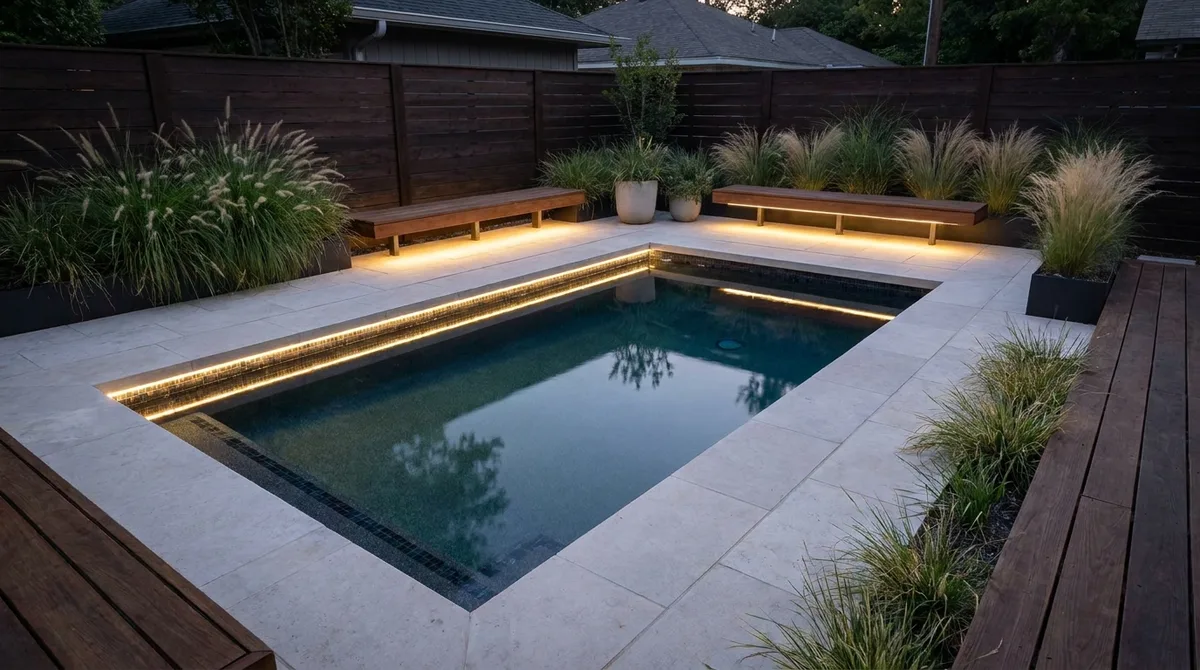
Compact plunge pool. A small, deep dark pool suits tight lots, feels bigger thanks to the reflections and costs less to heat. The same simple mindset drives the stock tank pool trend.
Infinity edge. A dark floor lets the water melt into the horizon. It’s the showpiece version and the priciest.
Tile waterline over pebble. A matte black or charcoal tile band gives a crisp outline, and the splash zone gets the toughest material.
Night-first design. Plan lighting before finish. Warm white LEDs on dark water glow like a lantern. The pool looks best after sunset, so design for it.
Stone and softscape. Pale limestone coping, ornamental grasses and wood tones stop the black from feeling heavy. A concrete patio in a light finish makes a clean, cool surround.
How do you test a color, and what are the dark-but-not-black options?
Test color in water, in your own yard and light. Ask for wet samples, view them in sun, shade and evening, and visit a finished pool of the same finish that’s several years old. Dark-but-not-black shades such as French grey, slate or deep blue often win.
A dry chip on a table lies. Water changes depth, tint and reflection, and the sky and trees change it again. Put the chip in a bucket outside and look at it morning, noon and dusk. Ask your builder for older jobs in the same finish and ask how the color changed after three to five years. Then compare your first choice with one shade lighter. Many people switch.
Here’s the pool-forum consensus I agree with: go dark, not black. Redditors suggest blues and earth tones. Mid-dark colors have room to soften, so when they fade one step you barely notice. Dark blue pebble blends such as Majestic Sound give a deep-water look with natural variation. Charcoal fiberglass gives a consistent look and a short install. My rule: pick the darkest shade you’d still like after it fades one step lighter.
Will a dark finish hurt resale or HOA approval?
The effect on resale is unclear because no solid data exists. One owner says a dark pool helped sell their house, while others fear buyers see a replaster bill. Check HOA rules, permit requirements and your insurance before you finalize the color. Keep receipts and records of the finish, startup and water care so a future buyer can see how it was maintained.
Keep this honest: the evidence is anecdotal. What you control is the paperwork. Some HOAs limit pool finishes, so ask before you sign. Most areas require a permit for a new pool or resurfacing, and codes vary. Call your insurer too. A clean dark pebble pool with documented care can read as a premium feature, while a blotchy grey one reads as a liability. Keep receipts for the finish, startup and water care.
Frequently Asked Questions
Are black pools hotter?
Slightly, but less than most people think. A dark bottom absorbs a bit more sun, so water can feel warmer on bright days. Owners and contractors describe the effect as small. A cover, shade and heater matter far more than color. A solar blanket is the cheap way to add warmth on any finish.
Do black pools fade?
Black plaster usually does, sometimes turning splotchy within months or a few years. Dark pebble and tile hold color far better because it lives inside the stone or glass. Good water balance slows fading on any finish. If you want a very dark look that lasts, price pebble before plaster.
Is black pebble better than black plaster?
For most owners, yes. Pebble often costs double or triple plaster, but the color is built into the stones, so it fades and mottles less, and contractor sources suggest 15 to 20 years of life. Plaster is cheaper up front but riskier in dark shades. Compare cost per year, not sticker price.
Are black pools more expensive?
Usually, once you choose a durable finish. No source I found shows a color premium for plaster itself, but pebble and tile run noticeably higher. Size, region and contractor drive the total, so collect two or three written quotes. To budget the space around the pool, see these patio design ideas.
Are black pools safe?
They can be, with planning. Dark water hides depth and steps, so add contrasting edges, mark ledges, use strong lighting and supervise closely. Local barrier and permit rules apply and vary. With toddlers, consider dark grey or deep blue instead of pure black for better visibility.
Do black pools show dirt?
They show leaves, pollen and light debris clearly, which makes skimming easy to judge. They can hide fine silt, dark algae and early scale. A robotic cleaner and weekly water testing cover that blind spot. Don’t trust your eyes alone, because chemistry problems can sit quietly below the surface.
Can I paint a pool black?
You can, but it’s a short-term fix, not a permanent finish. Pool paint wears from chemicals, sun and swimmers, and it needs careful prep and eventual recoating. How long it lasts depends on the paint and the surface, so ask a pool pro and the paint maker whether your pool can even be painted first. This is the myth-buster: paint is not a shortcut to a lasting black pool.
Does black plaster turn grey?
Often, yes. Contractors in forum threads say it can fade to grey within a few months, even with careful chemistry, especially in strong sun. Uneven curing, scale and etching speed it up. Many pros won’t go darker than French grey in plaster. For deep black, choose dark pebble or glass tile.
Do black pools hurt resale?
Nobody has solid data. One owner says a dark pool helped sell their home, and others worry buyers dread a replaster bill. A well-kept dark pebble pool with documented care tends to read as premium. Check HOA rules before building.
What is the best black finish for a hot climate?
Dark pebble or tile with a cover and some shade is the sturdiest combo. Stone and glass hold color against strong sun, and a cover cuts heat and evaporation. In very hot, full-sun yards, consider dark grey or blue instead of true black so the water doesn’t feel too warm. Ask local builders what holds up nearby.
Conclusion
A black pool isn’t a bad idea. A black plaster pool, ordered for the color alone, often is. That’s the real lesson hiding behind the forum arguments. The look you want comes from the material underneath, so choose pebble or tile for true black, or go dark-but-not-black if budget or kids push you there.
Hold on to three habits. Test wet samples in your own light. Design the safety contrast and lighting before the finish. Plan for a daily cleaner and weekly water tests. The heat claim is mostly noise, and a cover beats color. My opinion, not a measured trend: charcoal and deep blue pebble blends are the safest way to get the look.
Your next step: ask two builders for written quotes on pebble and tile, and visit a pool that’s several years old. For the rest of the yard, read our guide to the natural pool approach and these concrete patio ideas for a clean, cool surround.
So here’s the question to sit with before you sign: will you still love it after it fades one shade lighter?