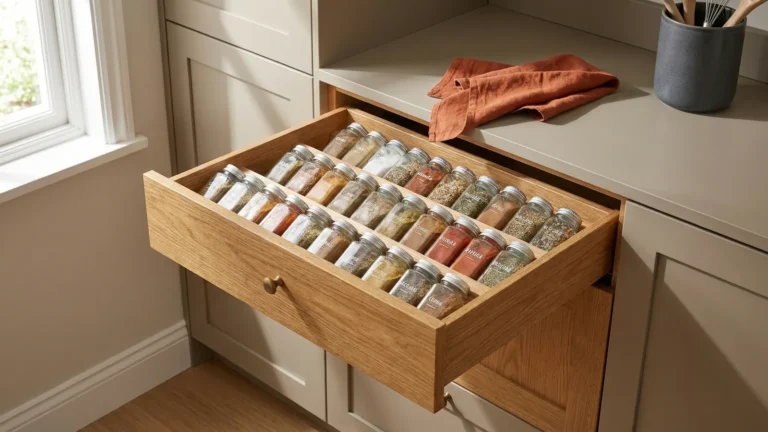
Spice Drawer Organizer: Fit More Jars Without Overflow
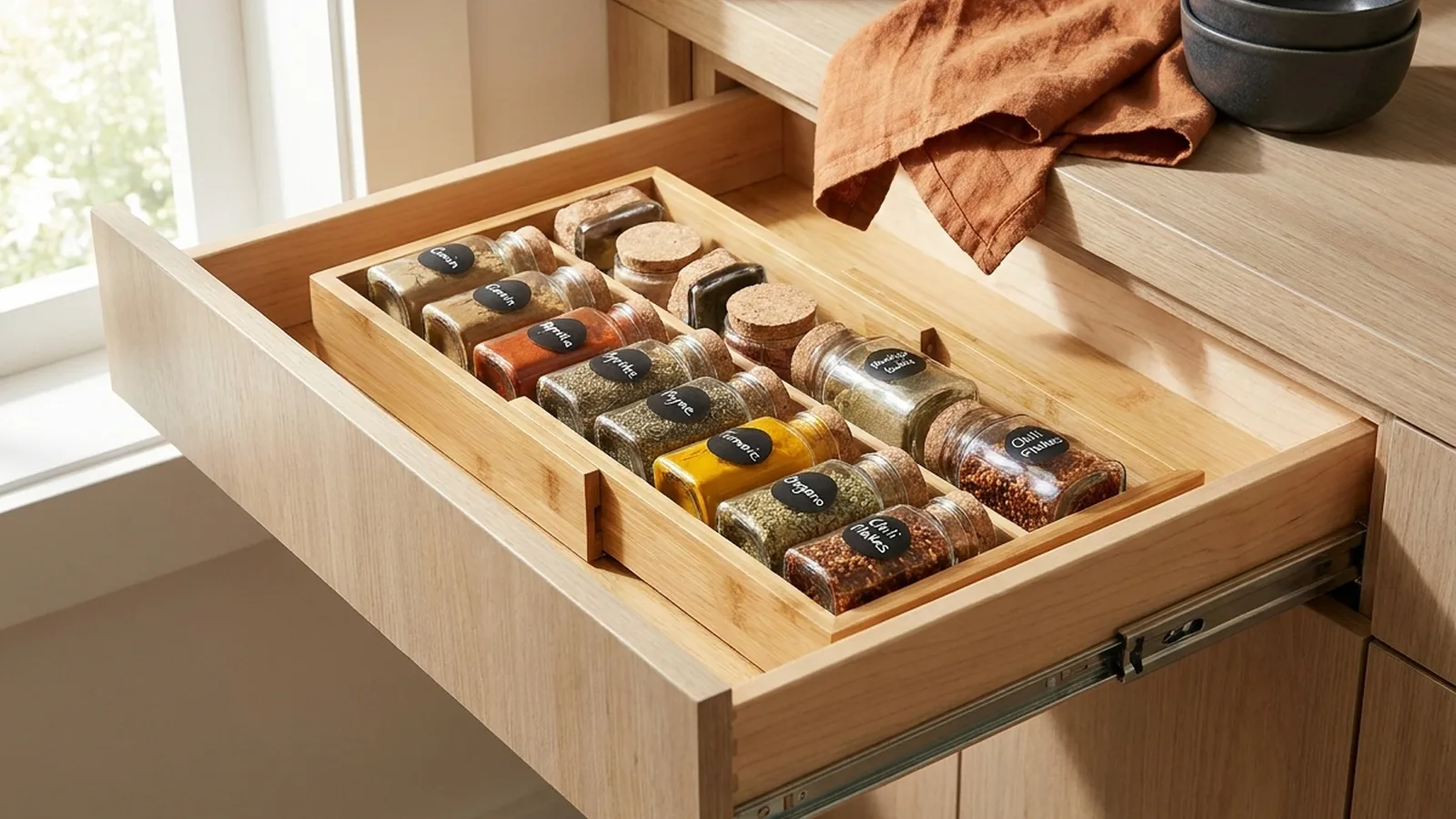
Say you finally buy a spice drawer organizer, slide it in, and the drawer won’t close. Two jars stand a quarter inch too tall. Or the insert rattles around because you guessed the width. Now you have a return label, a drawer of loose jars, and the same spice avalanche you started with.
Here’s the part most people miss. The organizer is the easy bit. Your drawer’s inside measurements and jar sizes decide whether it works. Buy in the wrong order and even a good product fails.
This is one part of organizing a kitchen so things stay put, and this guide stays inside the drawer. You’ll learn how to measure, which style fits, how to lay jars out and what it costs. Prefer a wall or door setup? Our guide to choosing the right spice rack organizer covers that side.
Executive Summary
Short version: measure the drawer first, buy jars second, and pick the insert last. That order prevents almost every return and wasted weekend.
You’ll get a simple way to measure your drawer, a style table that matches each insert type to the drawers it suits, and a layout based on how often you reach for each jar. We also make the case for decanting oversized containers, give a relative budget ladder with one sourced price, and use dimensions from Rev-A-Shelf, IKEA and Century Made as examples.
The biggest worry is "will it even fit?" In most standard base-cabinet drawers, yes, if you check the height. A shallow drawer isn’t a dead end either, because a flat tray often beats a tiered one there. And if your collection is huge, a rack may beat the drawer, which we cover near the end.
What is a spice drawer organizer and is it worth it?
A spice drawer organizer is any insert, tray or liner that keeps spice jars in order inside a kitchen drawer. Most lay jars flat or tilted so labels face up. It’s worth it if you have a drawer near the stove and a collection that has outgrown the cabinet shelf, because it ends the digging.
Without one, jars roll, labels hide and you buy a third cumin.
The trade-off: a drawer takes space you could use for utensils. If it’s your only utensil drawer, rethink, or keep the tall bottles and bulk refills on a shelf instead.
How do you measure for a spice drawer organizer?
To size a spice drawer organizer, measure the drawer’s inside width, inside depth and usable height, then measure your tallest jar with its lid on. Use the narrowest width you find, since slides can steal space. Write all four numbers down before you shop, and keep them in your phone.
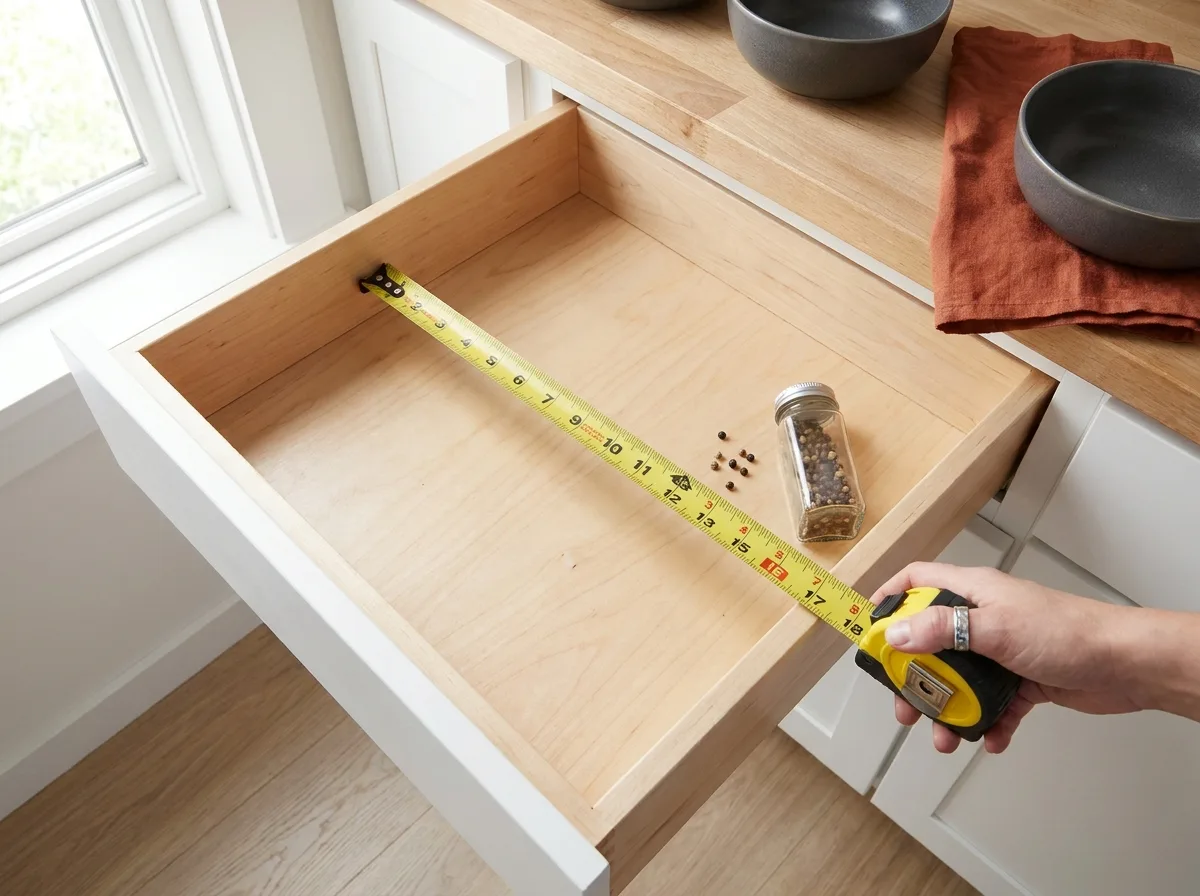
Most buying mistakes start here. The routine is quick with a tape measure and a notepad.
- Empty the drawer so you see the real floor.
- Measure inside width at the front, middle and back. Use the smallest number.
- Measure inside depth from the inside of the front panel to the back wall.
- Measure usable height from the floor up to the cabinet’s top rail with the drawer closed.
- Measure your tallest jar with its lid on.
Height surprises people most. Rev-A-Shelf’s 4SDI wood insert is about 1 9/16 inches high, so any jar on top must clear the rail with that added. Soft-close and full-extension slides can also narrow the opening, so measure what remains, not the box size.
Which spice drawer organizer style fits which drawer?
Pick your spice drawer organizer by drawer size and jar height. Tiered inserts suit deep drawers, flat expandable trays suit shallow ones, and custom wood suits standard sizes. Magnetic systems and liners suit people who like to rearrange. The table below judges each style on fit, strength and its main limit, so you can match it to your drawer.
| Style | Best for | Strength | Limit |
|---|---|---|---|
| Tiered or angled insert | Deep drawers | Labels visible at a glance | Wastes height in shallow drawers |
| Flat expandable tray | Shallow drawers, odd widths | Adjusts to your width | One layer of jars |
| Custom wood insert | Standard base drawers | Looks built in | Costs more, needs trimming |
| Magnetic modular rack | Frequent rearrangers | Reconfigurable | Needs matching jars |
| Non-slip liner plus dividers | Tight budgets | Cheap and flexible | Jars can tip |
A tiered insert raises the back row so every label shows. Rev-A-Shelf’s 4SDI series offers up to 3 tiers and trims to fit base drawers 36 inches wide or smaller. The catch is height. My opinion: skip tiered in any drawer with under about 3 inches of usable height, because jars will hit the top. A flat tray wins there.
Materials matter too. Solid maple, walnut and bamboo look good and tend to last, though they usually cost more and dislike soaking. Plastic and acrylic cost less and wipe clean, but can look less polished. Century Made’s 33 inch insert is solid maple with dovetail corners, measuring 33 by 1 1/16 by 19 3/4 inches. IKEA’s UPPDATERA tray (4 by 20 inches) fits MAXIMERA drawers 15 to 36 inches wide and 24 inches deep.
How many spices will a drawer really hold?
Fewer than the product photos suggest. Capacity comes from your drawer’s footprint, your jar diameter and any tiers. Count how many jars fit across one row, multiply by the number of rows that fit front to back, then subtract a small margin for dividers, slides and the gaps between jars.
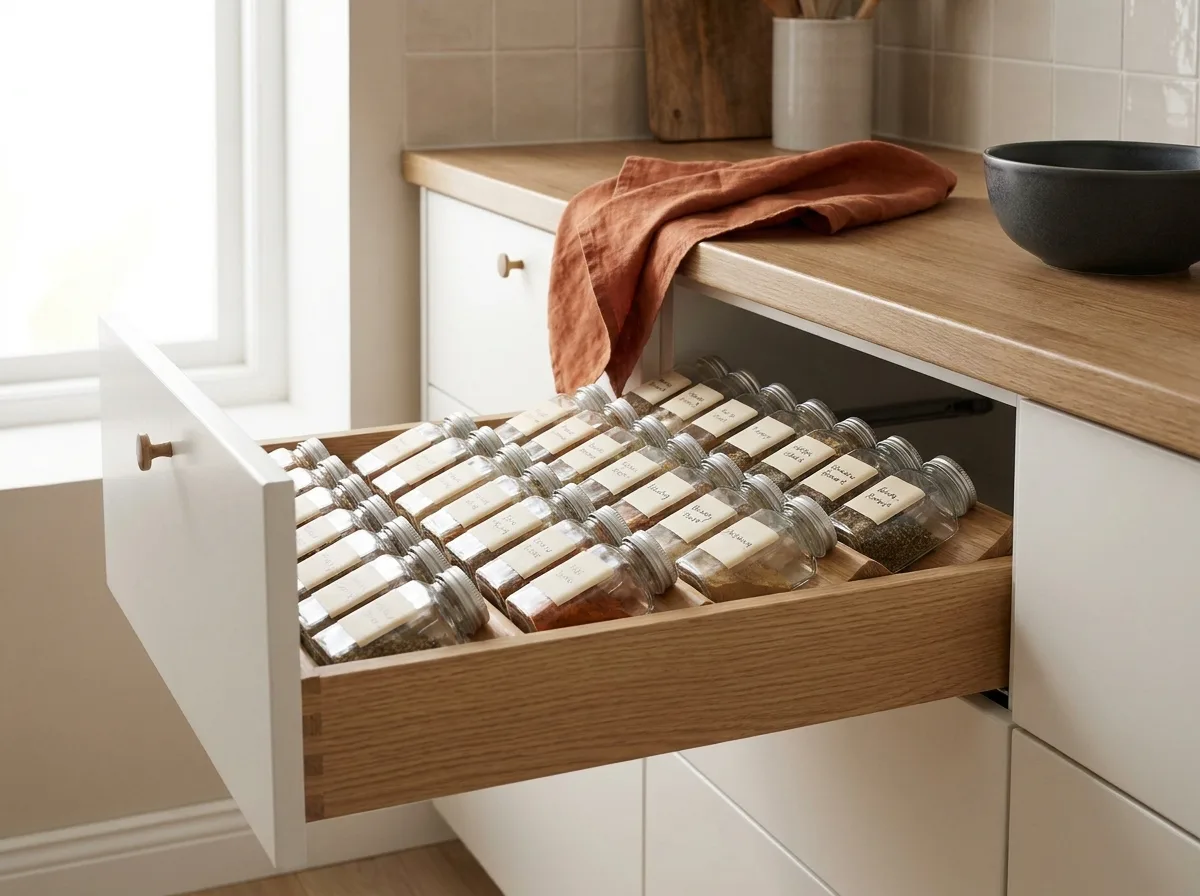
Picture a drawer 24 inches wide and jars are 2 inches across, so about 12 fit per row (hypothetical numbers). DrawerEssentials says its Stratford tray holds up to 45 jars in drawers up to 28 inches wide with 3 tiers. That’s a best case with small jars, so treat any big "holds 56 jars" claim the same way.
Contrarian bit: a bigger organizer doesn’t always hold more. Extra dividers eat space.
How should you arrange spices in a drawer?
Put the jars you use weekly at the front, nearest the handle, and rare ones at the back. Put labels on the lid top or the visible side. Alphabetical order suits big or shared collections, while cuisine groups suit cooks who repeat a few styles.
Think in zones. The front holds salt, pepper, cumin and paprika. The middle holds baking spices. The back keeps saffron and holiday spices.
Labels matter more than order. A thread in r/organizing suggested labels on both top and side. Sharing the kitchen? Go alphabetical. Cooking alone? Zones win.
Should you decant bulk spices before you buy?
Yes, if you buy big containers. Decant them into matching small jars, and buy the organizer after the jars, not before. Uniform jars fit predictably, and oversized bottles are what usually break a drawer plan. Keep the backstock in a pantry bin, not the drawer.
A cook might own a warehouse-size paprika and mismatched grocery shakers. No tray fits them all. Matching jars solve it.
The downside: matching jars cost money and refilling takes time.
What does a spice drawer organizer cost, and can you DIY it?
Costs span a wide range. A basic plastic tray is the low end and a custom wood insert is the high end. Rev-A-Shelf lists its 4SDI at $102.99 on its own page, though prices change. Our research found no verified price ranges for the other tiers, so treat the ladder below as relative guidance only.
A typical ladder runs low, middle, high. Low is shelf liner and craft-wood dividers (driver: your time). Middle is a plastic or acrylic expandable tray (driver: brand and tiers). High is solid maple or walnut with dovetail corners (driver: wood and trim-to-fit work).
DIY works for odd-sized drawers: cut thin wood strips into grid dividers over a liner. My take: buy the middle tier for a rental and the high tier for a kitchen you’ll keep.
How do you install a trim-to-fit insert?
Measure, mark, trim a little at a time, test the fit dry, then drop it in. Trim-to-fit inserts like the Rev-A-Shelf 4SDI are drop-in, so no screws are needed. All you typically need is a pencil, a tape measure, a fine-toothed saw and some patience, and the job can be done in one sitting.
- Measure the empty drawer’s inside width again.
- Mark the trim line on the underside with a pencil.
- Trim a little at a time with a fine-toothed saw, or ask a shop to cut it.
- Test the fit with no jars, then with your tallest jar.
- Drop it in and add a thin non-slip liner if it slides.
Cutting too much is the common error with any spice drawer organizer insert, and it’s permanent. Sneak up on the line.
What are the common spice drawer mistakes and fixes?
The biggest mistakes are buying before measuring, ignoring jar height, choosing tiered for a shallow drawer, and leaving no gap for slides. The fixes are simple: measure first, test with a real jar, switch to a flat tray when height is tight, and trim a hair less than you think you need.
A common version of this story: a buyer orders a wide 4-tier acrylic rack, then finds the closed drawer won’t clear. The fix is a flat tray, with tall bottles moved elsewhere. Another is the double-drawer annoyance: an r/ikeahacks thread described a hidden inner spice drawer that meant opening two drawers each time.
A third version is the over-trim. A DIY-minded owner cuts a trim-to-fit insert too short, and it slides around with every pull. The fix is a thin non-slip liner underneath, plus a lesson to cut a little at a time next time.
How do you keep a spice drawer clean?
Empty it every few months, vacuum the crumbs, wipe the tray with a damp cloth and let it dry fully before refilling. Wood needs a light wipe only, since soaking can swell the joints, while plastic and acrylic can take a quick rinse in the sink.
A handheld vacuum picks up loose seeds, and a damp cloth handles the sticky film. IKEA lists its UPPDATERA tray as wipe clean, a point for plastic.
When is a rack on the door or counter better than a drawer?
A rack is better when your collection is large or your drawers are shallow. A door or counter rack holds more in less space and keeps labels in view, while a drawer wins for tidy looks and quick reach near the stove. Pick by collection size and drawer depth, not by habit.
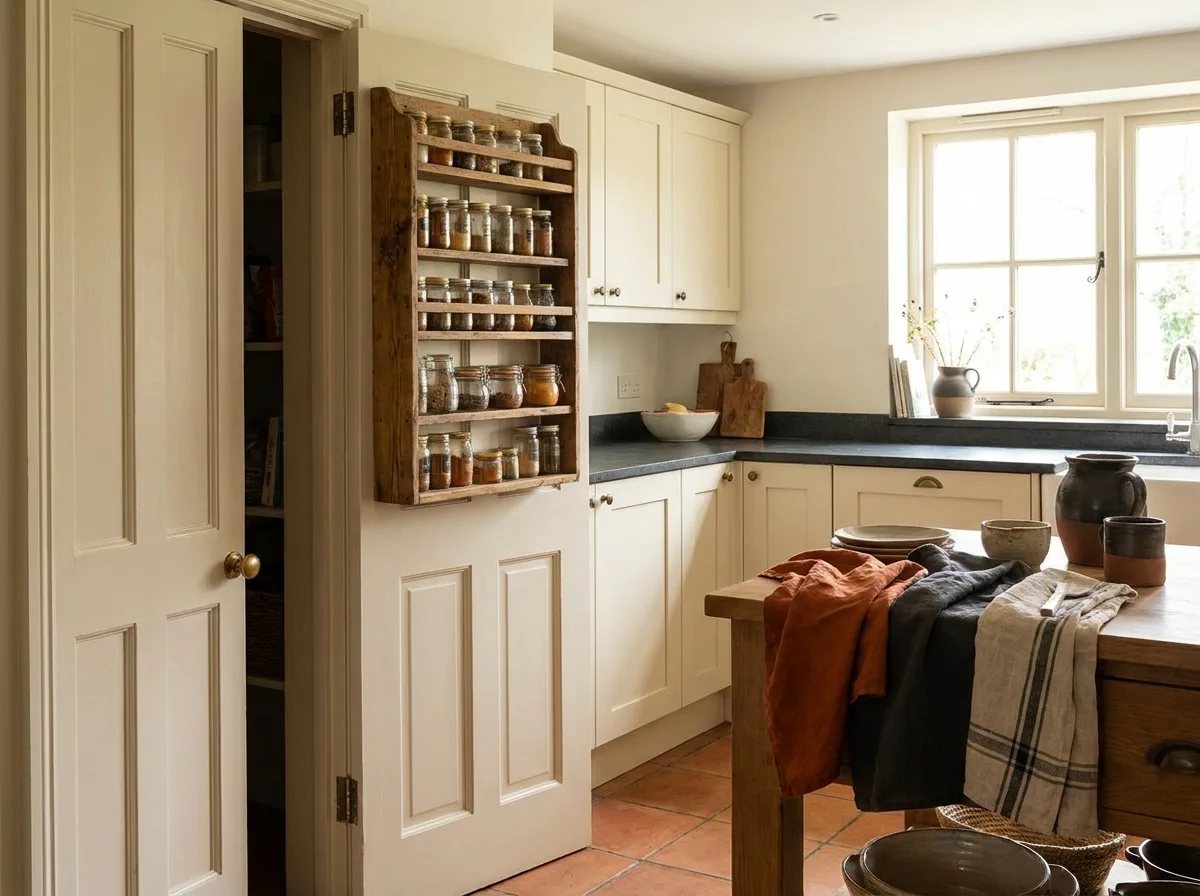
In the r/organizing thread, one user reported a door-mounted rack holding 70 to 100 spices, working for years with gentle door closing. That’s an anecdote, not a rule, but it shows why a spice drawer organizer isn’t always the answer.
Frequently Asked Questions
Do spice jars fit in a standard drawer?
Usually yes, if the jars are small shakers and the drawer is deep enough. Height is the catch, so compare your tallest jar with the drawer’s usable height. Tall bottles may need a shelf instead. A shelf or pantry bin is a better home for them.
Is a tiered spice drawer organizer worth it?
They’re worth it in deep drawers where the back row would otherwise hide. They aren’t worth it in shallow drawers, where jars can hit the top or sit awkwardly at the back. A tiered design shows every label at once, which saves time when you cook. Check your usable height first, and if it’s tight, choose a flat tray.
Can you cut a spice insert to size?
Yes, if it’s a trim-to-fit model. Rev-A-Shelf’s 4SDI is designed for that, in widths from 3 to 16 inches. Cut a little at a time with a fine saw and test often, because wood can’t be added back. A shop can also cut it for you. Standard trays like IKEA’s aren’t meant to be cut.
Is wood or plastic better?
Neither wins every time. Wood looks built in and lasts for years, but it costs more and dislikes soaking. Plastic is cheaper, wipes clean easily and forgives spills, though it can look less polished beside real cabinetry. Pick wood for a kitchen you’ll keep and plastic for a rental.
Will spices lose flavor in a drawer?
Not faster than elsewhere, if the drawer is away from heat. Light, heat and air are commonly advised against for ground spices, so a closed drawer is a decent home. Keep it off the oven side and seal lids tightly after each use. Smell a jar before you toss it.
Can you put one in a shallow drawer?
Yes, but choose a flat expandable tray rather than a tiered one. Lay short jars in a single layer, or set tall ones on their sides. A shallow drawer has less height, so you trade stacking for one tidy layer that is often easier to read anyway, and you skip the lid-bump problem.
How deep should a drawer be?
Deep enough that the organizer fits with the drawer closed. Products vary, so compare the insert’s depth with your measurement. Rev-A-Shelf lists depths from 5 3/16 to 19 3/4 inches, so there’s room to match. Leave a gap for the slides.
Do you need a liner?
Not always, but it helps any spice drawer organizer. A thin non-slip liner stops trays and jars from sliding every time you open the drawer. It also catches spilled powder. If your insert has non-slip feet, skip it.
Does a bigger organizer always hold more jars?
No, that’s a myth. Extra dividers, thick sides and tiers can eat space, so a plain tray sometimes fits the same number. Capacity depends on the drawer footprint and jar size, not the organizer’s size. Count jars by row before you buy anything larger, and picture the layout on paper first so you can see the wasted gaps.
How do you label spices for a drawer?
Put the name on the lid top and the front or side of the jar. You’ll read the top when the drawer opens and the side when you lift a jar. A date on the bottom tells you when to replace it. Keep the backstock elsewhere.
Conclusion
The surprising truth about a spice drawer organizer is that the product matters less than the order you buy things in. Measure the drawer, settle on jars, then choose the insert, and the spice avalanche from the start never happens.
A good spice drawer organizer is tiered in deep drawers, flat in shallow ones, and a rack on the door suits a collection that has outgrown the drawer. In my opinion, odd-sized drawers are the easiest to solve with a trim-to-fit piece.
Your next step with any spice drawer organizer is small: grab a tape measure and write down four numbers. If a wall or door setup suits you better, read our spice rack organizer guide next, or see how a storage chest can hold the backstock.
So which jar is hiding at the back of your drawer right now?