
Closet Doors: Types, Costs and How to Choose (2026 Guide)
Picture this. You open your bedroom closet and the sliding panel jumps off its track again. Or a contractor hands you a quote that makes four plain doors look like a kitchen remodel. Either way, you’re now shopping for closet doors, and every store page shows you pretty photos but no way to decide.
I’ll give you the decision rule instead. I’m sceptical of upsells, so you’ll also see where a plain door beats a fancy one, and when to skip the door altogether.
What You’ll Get From This Guide
- A quick way to match a door type to your closet size and how you use it.
- Typical installed cost ranges per type, with what pushes the price up.
- Measuring steps, a DIY check, and fixes for the most common failures.
What are the main types of closet doors?
Most homes use one of four types: bifold, bypass (sliding), hinged (including French), or pocket. Barn-style, accordion and pivot doors fill the gaps. Each type trades off between how much of the closet you can reach, how much floor space the door needs, and how much it costs.
Here is the short comparison before the detail.
| Type | Access to the closet | Floor space needed | Best for |
|---|---|---|---|
| Bifold | Wide opening | Folds into the room a little | Standard bedroom and hall closets |
| Bypass (sliding) | About half at a time | None | Tight rooms with furniture near the closet |
| Hinged or French | Full opening | Needs door swing space | Shallow closets, formal rooms |
| Full opening | None, but needs wall work | New builds and remodels | |
| Barn | Full opening on a wide track | Needs clear wall beside it | Wide openings, style-first rooms |
Notice that no type wins on every row. That’s the whole game. You pick the weakness you can live with.
Are bifold closet doors the right default?
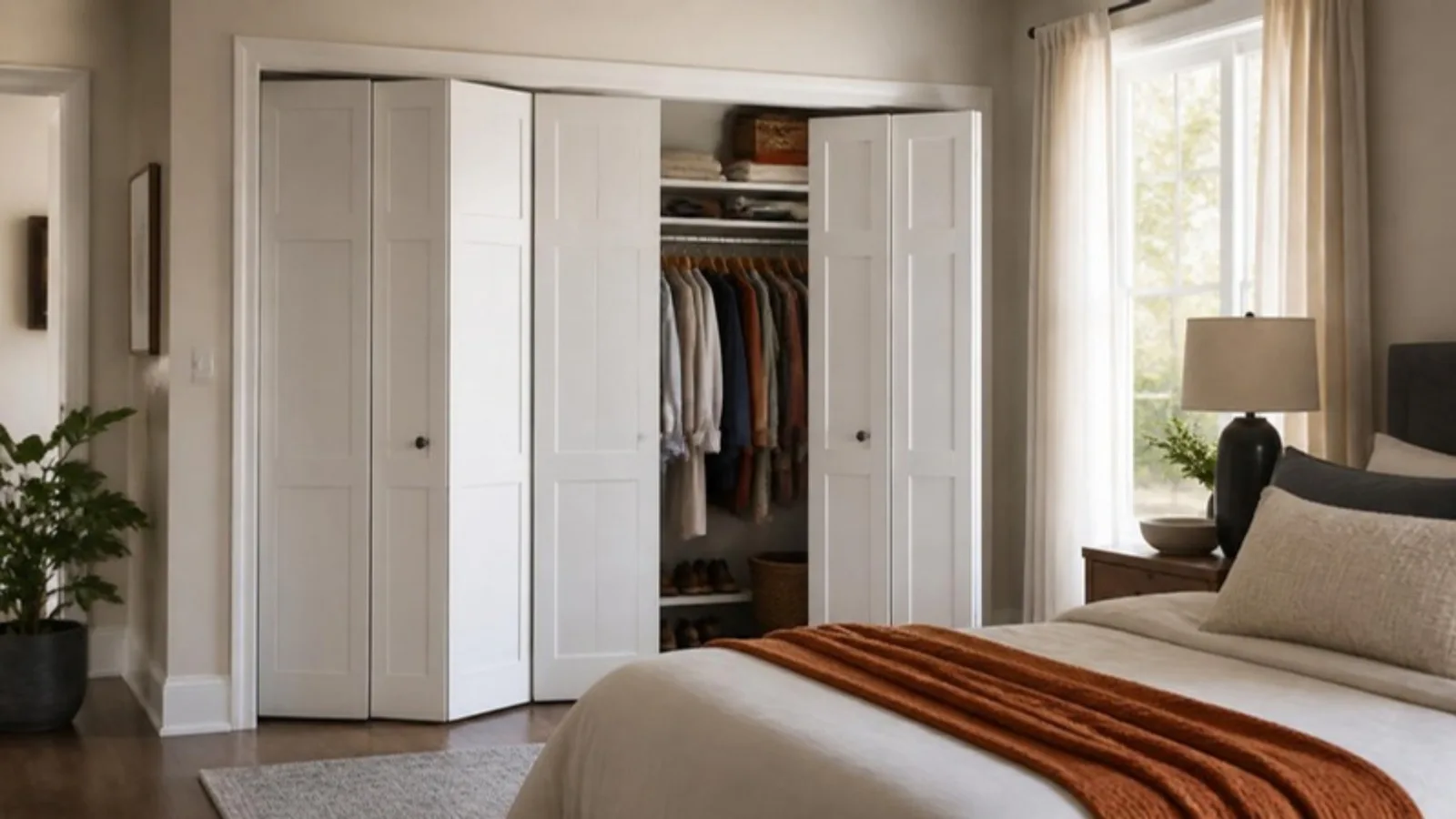
Bifold doors are the most common answer because they open wide and cost little. They use a top track and hinged panels that fold toward one side. Every panel sits inside the opening when open, so you give up a few inches of width on each side. Rustica notes that bifold doors project into the room when they fold, so you need some clearance in front.
You’ll also hear them called folding closet doors, and most owners start here. Their weak spot is hardware. Cheap tracks and pivots wear out, and a poorly hung bifold pops off its track. More on that fix below.
What do modern bifold closet doors look like?
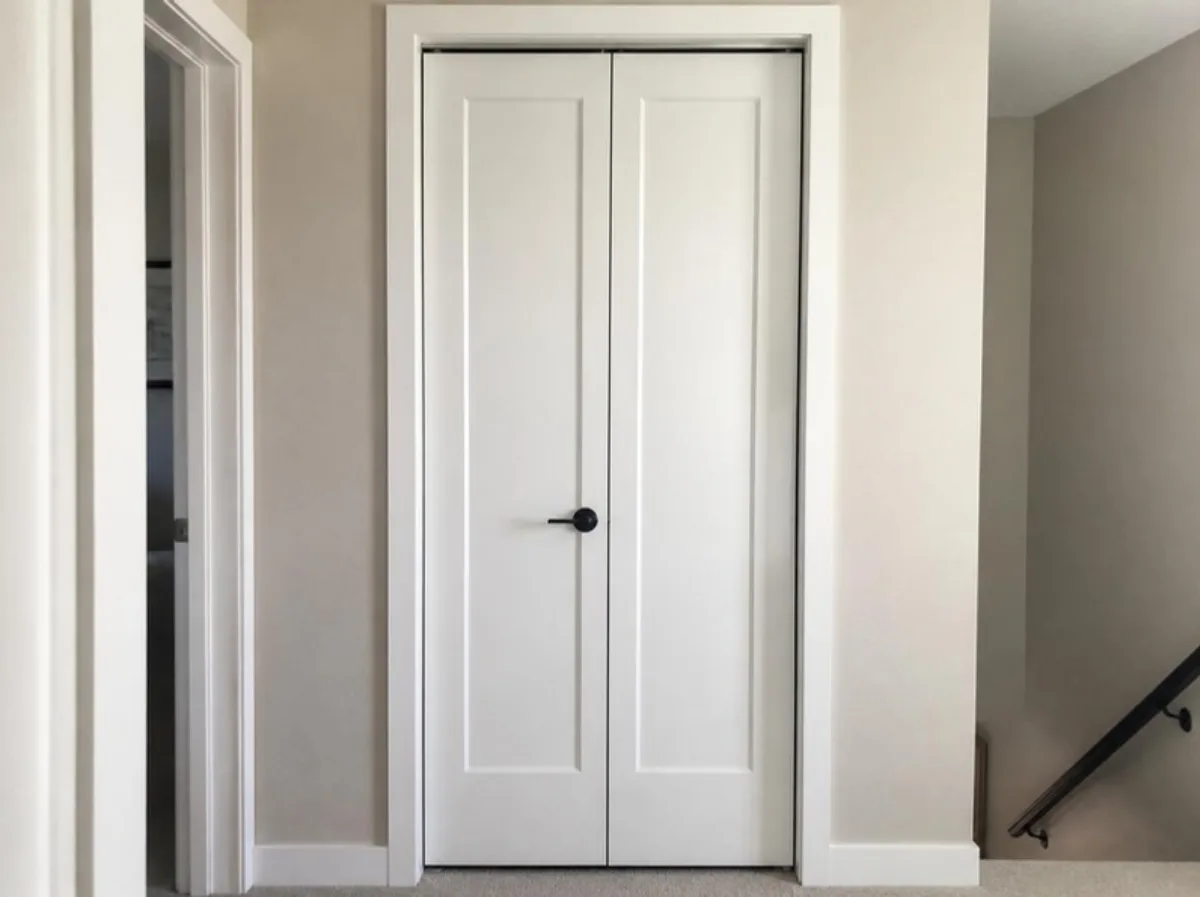
Modern bifold closet doors usually mean flat or shaker-style panels in a solid color, with clean hardware and no visible gaps. A white or soft gray finish in a plain shaker panel suits most bedrooms. If you want something less dated than the old louvered look, pick a smooth panel and a matte paint finish.
Louvered panels still suit laundry closets, where the slats let air move and humidity can build up. In a bedroom, I’d skip them.
Bifold or bypass closet doors: which is better?
Choose bifold if you want to reach most of the closet at once. Choose bypass closet doors if you need zero swing space. A bifold gives wide access and usually costs less than the other types. A bypass door gives about half the opening at any moment, because one panel always blocks the other side.
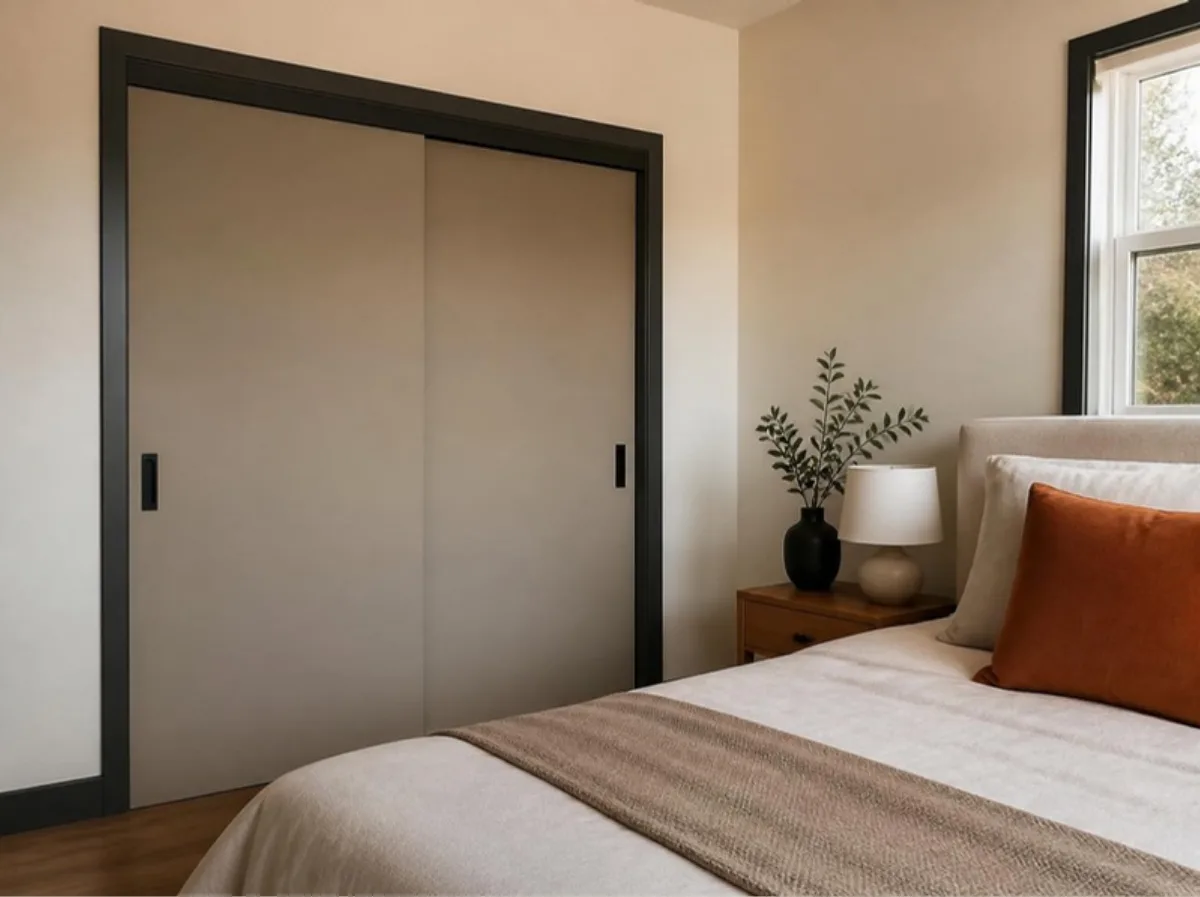
One retailer, Elizabeth Shutters, says a two-panel bypass leaves roughly 50 percent of the closet open, while a bifold leaves about 80 to 90 percent. Treat those as a seller’s estimate, not a lab result. A Houzz forum reply puts it in similar terms, saying a bypass blocks about half the width while a bifold blocks only a few inches on each side. The direction is consistent across sources even if the exact numbers vary.
Say your closet sits across from your bed with only 2 feet of walking space. A bifold may hit the bed frame. A bypass won’t. Now say it opens onto a wide hall. The bifold wins, because you can see everything at once.
Use this rule:
- Pick bifold if you want easy access and have a foot or so of clearance.
- Pick bypass if furniture sits close to the closet or you hate doors that stick out.
- Skip bypass for a closet where you need to see everything at once, such as a walk-in you use daily.
How much do closet doors cost to buy and install?
Closet door installation typically runs from $250 to $2,500 per project, and the door alone can run from $50 to $1,700, according to HomeGuide’s 2026 cost guide. Type, size, material, and hiring a pro drive that spread. Labor alone is $200 to $800 per door, per the same guide.
Here are the ranges HomeGuide gives by type.
| Type | Door only | Installed |
|---|---|---|
| Bifold | $80 to $300 | $250 to $800 |
| Sliding (bypass) | $50 to $1,700 | $250 to $2,500 |
| French | $300 to $1,500 | $600 to $3,000 |
Read the table as a map of drivers, not a promise. Material pushes the price most. A hollow-core MDF panel sits at the bottom, while solid wood, glass, and mirror sit at the top. Custom sizes, special finishes, and new framing add more.
Watch for the quote trap. Homeowners on Reddit describe quotes in the thousands for a handful of plain doors. Those are anecdotes, not market data, but they point to a smart habit: ask for materials and labor listed separately. If the quote is far above the ranges here, ask what you’re paying for.
What are the best closet doors for a small bedroom?
For a small bedroom, bypass or pocket doors usually work best because neither swings into the room. Choose bypass if you want the simplest fix, since it needs no wall work. Choose pocket only if you’re already opening the wall, because it costs more and needs carpentry. Choose bifold if budget matters most and you can spare a little clearance in front.
Bedroom closet doors have one job in a small room, which is to stop stealing floor space. A hinged door needs a clear arc, a bifold needs a smaller one, and a bypass needs none. Check where your bed and dresser sit before you fall for a style.
A mirrored bypass door adds a full-length mirror without a separate stand. The trade-off is weight, so the track has to be solid.
Are French closet doors worth it?
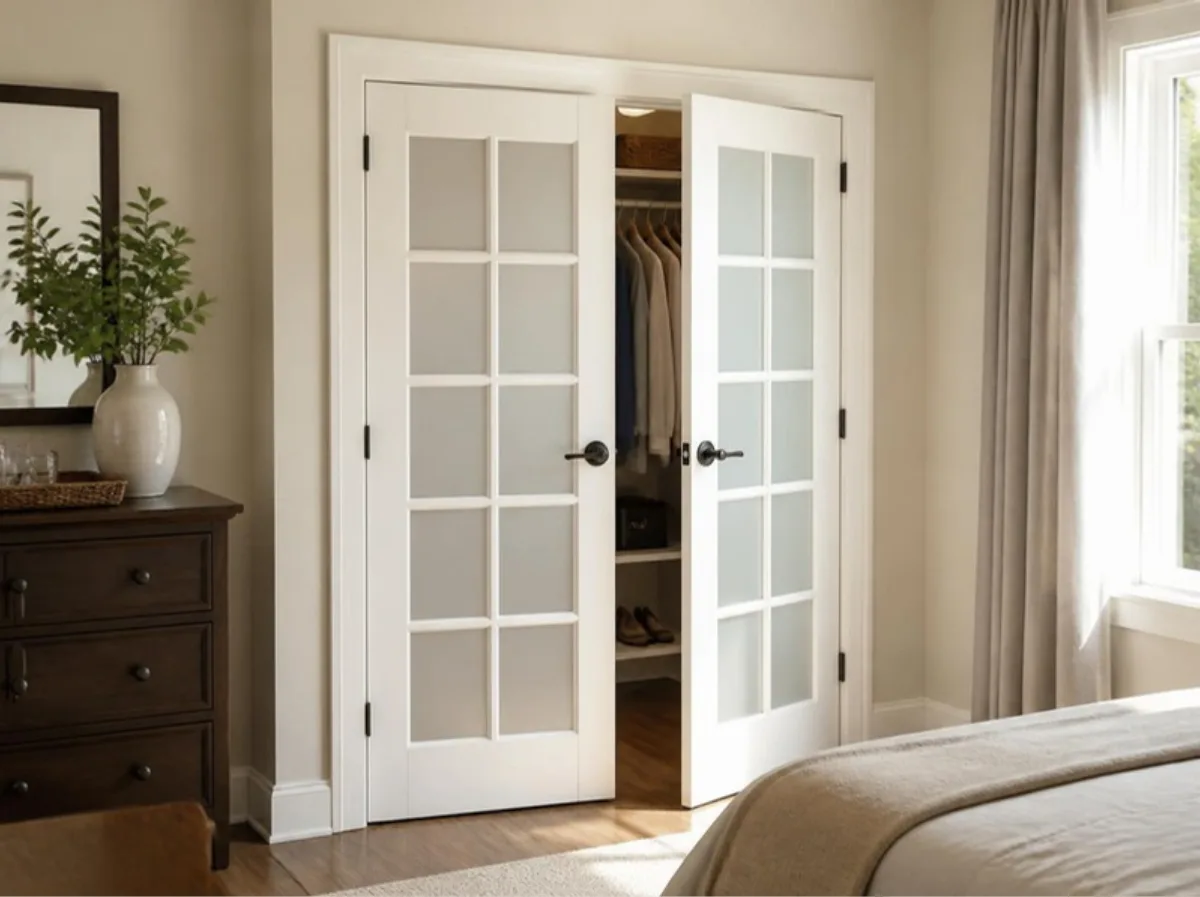
Yes, but only for the right room. French closet doors give a full opening and a formal look, and they suit shallow closets or dining-room-style cabinets. They need swing space and cost more than a basic bifold, so they’re a poor fit for tight bedrooms.
Do french closet doors suit a bedroom?
French closet doors can look lovely in a larger bedroom or a hall closet with a glass panel. They sit in the highest cost band in the table above. Glass panes show what’s inside, so you’ll want the closet tidy or a frosted pane.
If you’re replacing sliders with French doors, check the framing first. Bypass tracks sit in the opening, and the jambs may need work to hang hinged doors. That’s a carpentry job, so price it before you commit.
Do barn closet doors work in a closet?
They work if you have a clear stretch of wall beside the opening, and you accept that a barn door slides on a visible track and doesn’t seal tightly. They suit wide openings and a bold look. They’re a weaker choice in a shared bedroom where you want quiet and privacy.
A barn door glides on a rail, so it needs a blank wall segment about as wide as the door. If a light switch or bookcase sits there, the idea fails.
Are pocket closet doors worth the wall work?
Pocket doors are worth it when you’re already opening the wall, such as in a remodel or a new build. They slide into a cavity inside the wall, so they take no floor space and give a full opening. Rustica notes that pocket doors save the most space but need wall work. If you are planning a bathroom remodel at the same time, it is the best moment to settle door choices.
That’s the catch. Retrofitting a pocket in an existing wall can mean cutting drywall and moving wiring or plumbing inside it. Anything that touches electrical or structural parts is a job for a licensed pro, and permit rules vary by city and state, so check locally before demolition.
Mirrored, glass or louvered: which style fits your room?
Mirrored doors fit rooms where you want a dressing mirror and don’t mind a utilitarian look. Glass fits rooms where you want light and are happy to see inside. Louvered fits closets that need airflow. Solid shaker panels fit almost everywhere else.
Here’s how I’d weigh them:
- Mirrored: Practical and light-reflecting, but heavy, and often seen as dated. A modern frame helps.
- Glass: Opens up a dim hallway, but shows clutter. Frosted or reeded glass hides the mess.
- Louvered: Great for ventilation in a laundry closet. They gather dust and look busy in a bedroom.
- Shaker or flat panel: Neutral, easy to paint, and rarely out of style.
If you’re stuck, pick the shaker panel. It is hard to regret.
What material should closet doors be made of?
MDF and hollow-core doors are the budget choice, solid wood is the durable one, and glass or mirror is the style one. Material affects weight, which affects hardware. Heavy doors need strong tracks and good hinges, or they sag.
A hollow-core door is light, cheap, and fine for a standard closet that nobody slams. Solid wood costs more and handles years of use better, and it holds paint well. MDF takes paint smoothly but swells if it gets wet, so keep it out of damp spaces. One Reddit reply praised solid wood bifolds with good hardware as a fix for constant breakage. That’s one opinion, but it matches how mechanical parts behave. Better hardware lasts longer.
Also decide between a prehung unit and a slab. A prehung door arrives in its own frame with hinges attached, which makes hanging easier. A slab is just the door, and you fit it to an existing frame. A slab is cheaper and fine if your frame is square.
How do you measure for closet doors?
Measure the rough opening, which is the framed hole before any door or trim. Measure width and height in three places each and use the smallest number. Then match that to the door’s size, because stock sizes rarely fit odd openings without trimming or custom orders.
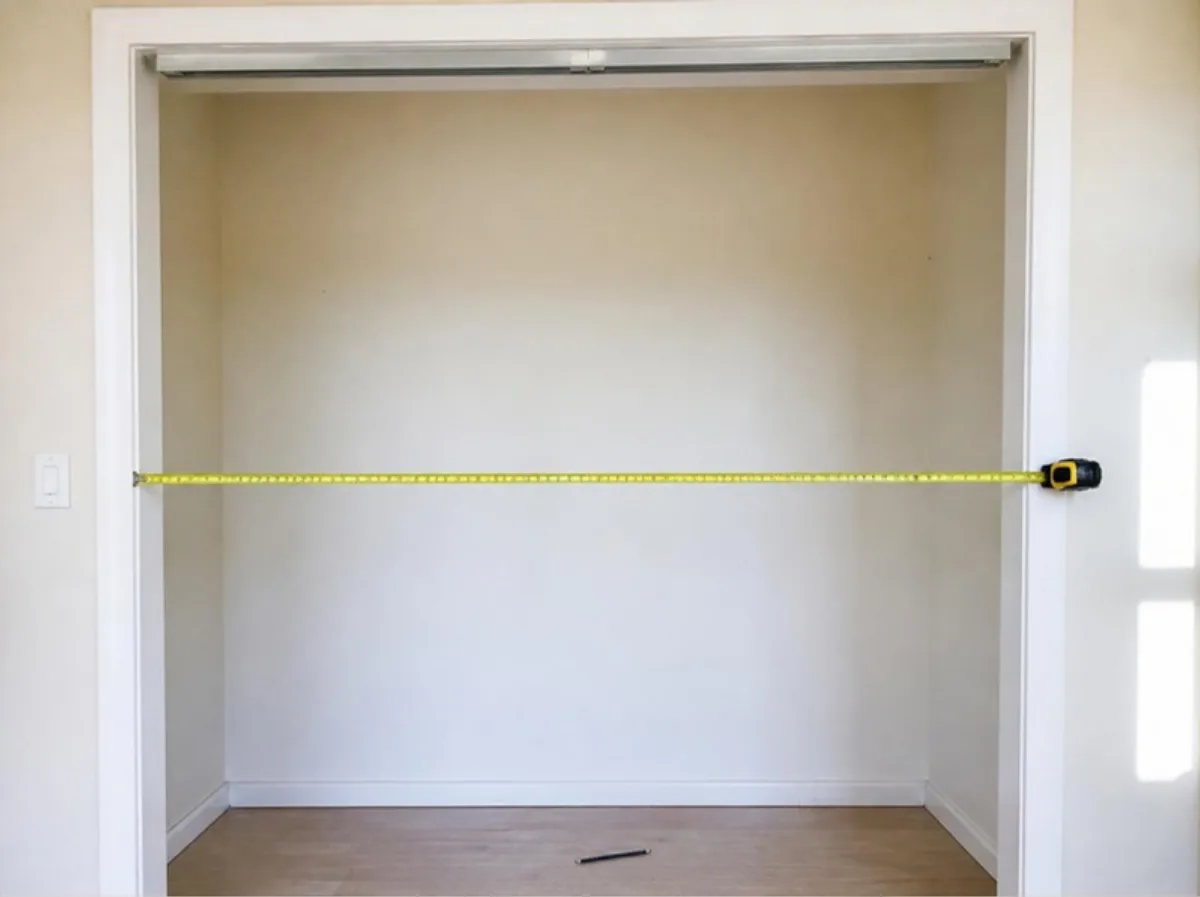
Teza Doors & Windows recommends adding about 2 inches to the combined bifold door width and about 2.5 inches to the height to get the rough opening size. Its chart lists an 80 inch door height with a rough opening of 82.5 inches, and widths from 24 to 72 inches. Use its rough opening guide for your exact door.
Follow these steps:
- Remove old doors and track so you can see the bare opening.
- Measure width at the top, middle, and bottom. Write down all three.
- Measure height on the left, center, and right.
- Use the smallest width and the smallest height.
- Check the opening for square by comparing the two diagonals. Big differences mean you’ll need shimming or a custom size.
- Compare your numbers to the door maker’s chart before you order.
A common mistake is measuring the old door instead of the opening. Old doors get trimmed, bent, and swapped over the years, so they lie.
Odd sizes are common in older homes. One homeowner described an opening that wouldn’t fit standard doors, and another asked what to do with a very wide opening that had no stock option. In those cases, you have three real choices: reframe the opening, use a pair of doors that split the width, or order custom sizes.
Can you replace closet doors yourself?
Yes, in most cases. Swapping a bifold or bypass set on a standard opening is a reasonable DIY job for most handy owners, and a plain swap often fits in a day. It gets harder when the opening is out of square, the track needs to be moved, or the framing must change.
Pro labor is a big slice of the bill, so DIY is attractive on a plain swap. Say you’re replacing two bypass doors on a standard closet. You’d skip the labor charge if you can level a track, drill into a header, and lift a heavy panel into place. If any of that sounds miserable, hire it out.
One honest warning from a Reddit poster: they regretted treating bifold adjustment as an easy afternoon job in an older home. Old frames shift. If your opening is crooked, hire a pro or plan extra time for shimming.
Why do bifold closet doors keep coming off the track?
Usually because the pivot pins, the top bracket, or the guide wheel is worn, loose, or out of alignment. Fixing those parts and re-hanging the door level solves most cases. If the hardware is cheap and bent, replace it instead of adjusting it.
Try this order:
- Lift the door out, then check the top pivot and the bottom pin for wear.
- Tighten the top bracket screws into solid wood, not just drywall.
- Adjust the bottom pivot until the door sits plumb and the gap is even.
- Lubricate the track lightly.
- If the door still pops open, replace the hardware set.
Bypass doors have their own version of this problem. They fall off the track when the wheels wear or the track bends. Replace the wheels and straighten the track before you give up on the door.
Replacement hardware is typically cheaper than new doors. If the doors are warped or the frame is badly out of square, replace them instead.
When is custom closet doors pricing worth it?
Custom closet doors are worth it when your opening is an odd size, extra wide, or part of a design-led room. For a standard opening, stock or made-to-order doors from a big retailer often do the same job for less.
Before you commit, ask a local home center for a made-to-measure price and compare.
Real reasons to pay for custom: a nonstandard height, a very wide opening, an unusual style, or a finish that must match other trim. Poor reasons: a plain shaker panel on a standard-size closet.
How do you make old closet doors look new?
Paint them, swap the hardware, and replace the worn track before you buy new doors. That costs a weekend and a few supplies.
Take the doors down, lay them flat, sand lightly, prime, then paint. Paint the edges and the backs too, since bifold backs show when folded. If the old doors are solid wood, repainting wins. If the panels are in bad shape, a plain new set is a quick install.
Does your closet need a door at all?
Not always. A closet without a door can be a clean look, and a curtain or open shelving can be a cheaper, roomier alternative. Skip the door if the closet is shallow, the space is a small walk-in, or you simply want more room and light.
The trade-offs are dust, privacy, and visual clutter. A curtain can hide the mess without door hardware, and if you rent, it avoids swapping out the landlord’s doors. An open closet can also be easier to reach for older family members, since there’s no track or panel to wrestle.
Frequently Asked Questions
What is the most popular type of closet door?
Bifold and bypass doors are the two most common. Bifolds win in many homes because they cost less and open wide, while bypass doors win where floor space is tight. There’s no single best type. Your clearance, budget, and how often you use the closet should decide it.
Are bifold closet doors outdated?
Not by themselves. Old louvered or builder-grade hollow panels look dated, but a smooth shaker-style bifold with decent hardware looks current. The reputation comes from cheap tracks that fail. If the hardware is good and the finish is clean, bifold doors can look fresh for many years.
How wide is a standard closet door?
Closet door widths vary by opening, so there isn’t one standard. Teza lists bifold widths from 24 to 72 inches, and individual panels are narrower. Measure your rough opening and match it to the manufacturer’s chart before you order, rather than guessing from the old door.
How tall are closet doors?
Teza Doors & Windows lists an 80 inch height with a rough opening of about 82.5 inches. Taller doors exist, and older or unusual homes may differ, so measure the opening in three spots and use the smallest number.
Can I replace bypass doors with bifold doors?
Often yes, because a bifold opens wider and many openings take either type. You’ll need to swap the track and hardware, check the clearance in front of the closet, and confirm that the width matches a bifold set. If the opening is odd or crooked, plan for shimming or custom sizing.
How much does it cost to replace closet doors?
Typical installed cost runs from $250 to $2,500, with the door alone from $50 to $1,700, per the HomeGuide cost guide. Bifold sets sit low and French doors high. Material, size, and labor drive the spread, so ask for line items.
How do I fix a bifold closet door that pops open?
Check the top and bottom pivots, tighten the bracket screws, and adjust the door until it hangs plumb with an even gap. Light lubrication on the track also helps. If the hardware is bent or worn, replace the set. A warped door or out-of-square frame may need new doors.
Are mirrored closet doors out of style?
Some find them dated, mainly the thick gold-trim and builder-grade versions. A mirror in a slim, modern frame still works in small bedrooms where you want a full-length mirror and extra light. If you dislike the look, you can often swap a mirrored panel for a flat painted one.
What closet doors work for a very wide opening?
Pairs of bifold doors, a long bypass set, or a barn door on a wide track can cover a wide opening. A three-door slider narrows the access, so many people prefer paired bifolds or custom doors. Measure carefully, because stock sizes often stop well short of very wide spans.
Do closet doors need to be painted on both sides?
It’s best to paint both sides, especially on wood or MDF, because even coverage helps the door resist moisture and warping. The backs of bifold doors also show when folded open. If one side faces a hidden space, a coat of primer on that side is the minimum.
The Bottom Line
Back to that sliding panel jumping off its track. You don’t need a thousand-dollar fix. Start with the opening itself: measure it, then pick the door type that matches your clearance and how you reach your clothes. For most standard bedroom closets that means a bifold if you have room or a bypass if you don’t.
Compare any big quote to the typical ranges above, and consider painting and new hardware before you replace anything. If the opening is odd, extra wide, or needs framing work, then it’s time to price custom doors or call a carpenter.
Next step: grab a tape measure tonight and write down your three widths and three heights. Then decide whether you value a wide opening or a clear floor more. Which one wins in your closet?



One Comment