Torsion Spring Garage Door: How to Read the Spec and the Quote
Say you back out on a cold morning, press the button, and hear a loud bang from the garage behind you. The door won’t lift. The opener hums and strains. Your car is stuck inside, and the first company you call quotes a price that sounds like a car payment.
That moment is when most people learn what a torsion spring garage door system really is. Is one spring enough? Most pros say replace both, and we’ll get to why. Why does the part cost so much less than the invoice? That’s covered too.
This guide is one part of understanding your garage door as a whole. No winding instructions, because this is a job for a pro. You’ll just walk into the conversation prepared.
Executive Summary
A torsion spring is a tightly wound steel coil on a shaft above your door. It does the heavy lifting, so your opener doesn’t have to. When it breaks, the door becomes very heavy and unsafe to move. Read its wire size, length and cycle rating, and you can judge any quote.
This guide covers how the spring fits among the other garage door parts, what the specs mean and why pros usually replace springs in pairs. It also covers reader-reported prices and what drives them, how long springs last, and when converting an older system makes sense.
DIY is the obvious question. The parts are cheap, but the stored energy is serious, so we’ll mark where DIY ends and hiring help is the smarter spend.
What does a torsion spring garage door actually do?
A torsion spring stores twisting force as it winds, then releases it to counterbalance your door. A closed door may weigh well over 100 pounds, yet the spring makes it feel nearly weightless. That’s why your opener motor can be small.
Think of it as a very strong coiled wire holding the weight of the door for you. One full trip up and down is one cycle.
Here’s the part most people miss about any torsion spring garage door: the spring does the work, and the opener mostly just guides it. That’s why running the opener against a broken spring is a bad idea.
Where do torsion springs sit among the parts of a garage door?
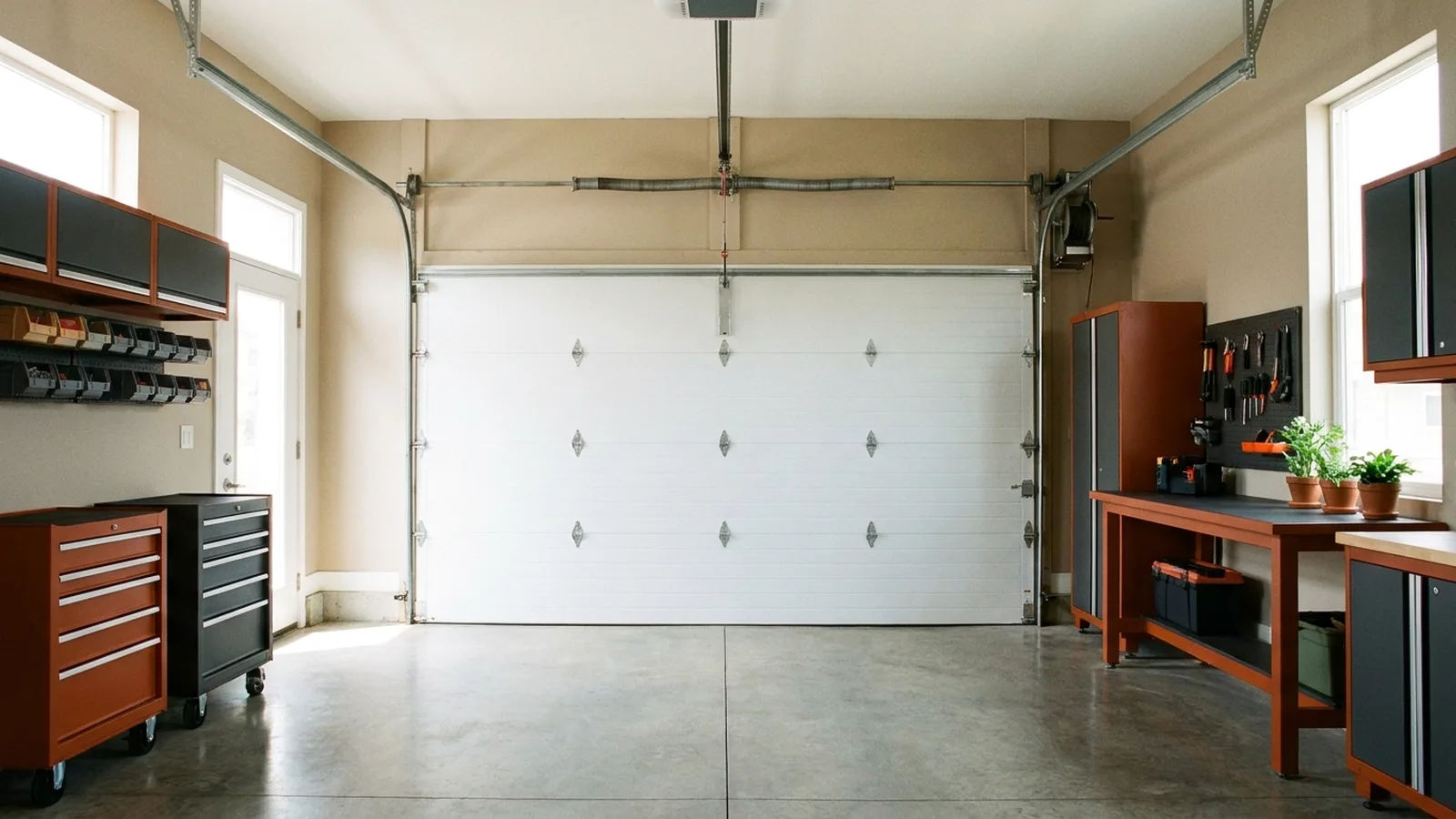
The spring sits on a steel shaft, called the torsion tube, mounted above the closed door. Cable drums at each end wind the lift cables, which run down to the bottom corners of the door. Center and end bearing plates hold the shaft, while tracks, rollers and hinges guide the door.
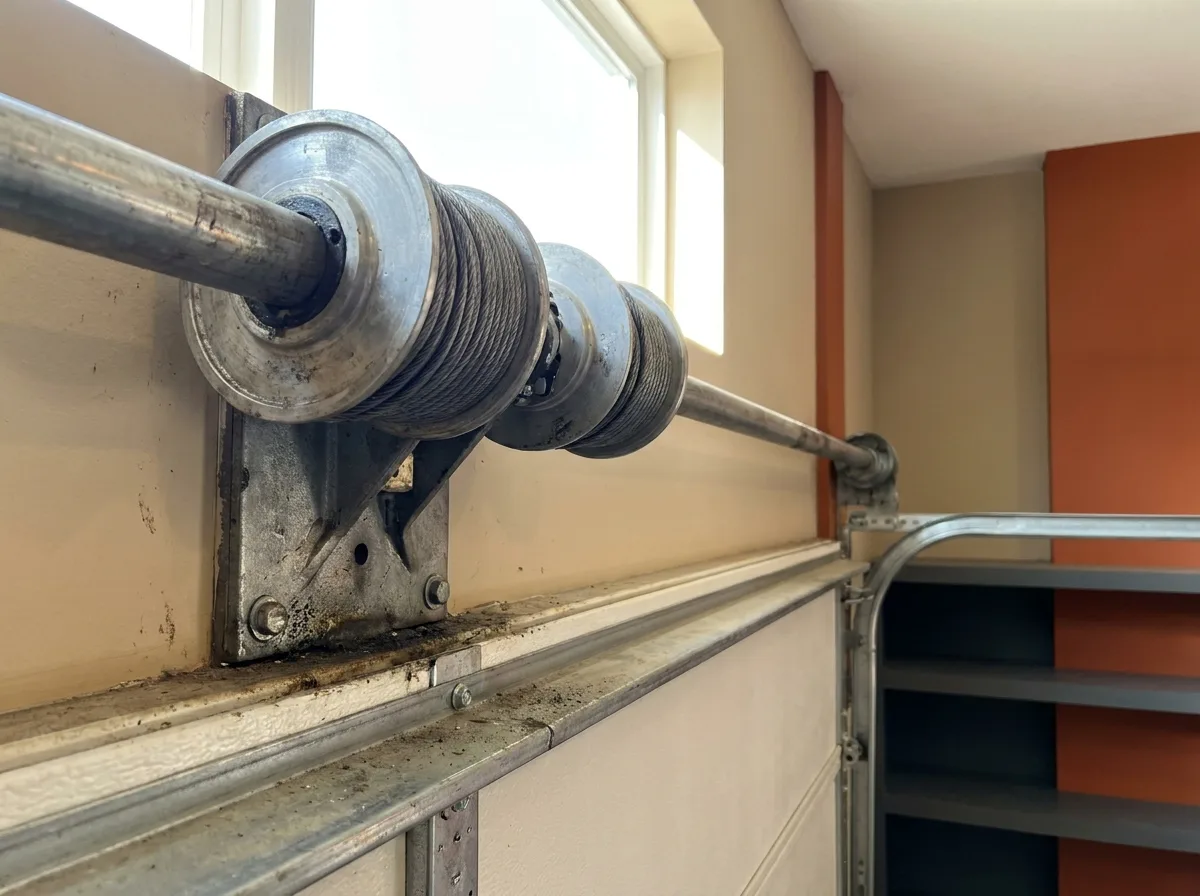
Knowing the parts of a garage door makes a service call much easier to follow. The winding cone is the fitting at the end of the spring where a technician adds tension.
If a cable snaps instead, the symptoms look similar but the repair differs. Our guide to replacing a garage door cable shows how to tell the two failures apart. If the door reverses or won’t close, check garage door sensor problems first.
Torsion spring vs extension spring: which is better?
A torsion setup is generally smoother, quieter and longer lasting than extension springs, which stretch along each side of the door. Extension springs cost less upfront and suit lighter doors. Many pros prefer torsion for heavier or busier doors.
Extension springs usually need safety cables to catch a broken spring, so check that yours has them. A torsion spring garage door usually carries higher cycle ratings, and a pro’s comment on Reddit put it at roughly 10,000 cycles for a basic extension spring versus far more for high-cycle torsion.
My opinion: if your door is heavy, insulated or used all day, lean torsion. For a light single door used twice a day, extension springs can be fine. Also, an extension-spring owner who replaces springs every 3 to 5 years should look for the cause, since an out-of-balance door often shortens spring life.
How do you read a torsion spring garage door’s size and cycle rating?
Every torsion spring garage door setup is described by four numbers: wire size, inside diameter, length and wind direction. Match all four, plus the door’s weight, and you have the right spring. Cycle rating tells you how long it should last. A commonly cited figure for a standard spring is about 10,000 cycles, while high-cycle versions reach 15,000 or more.
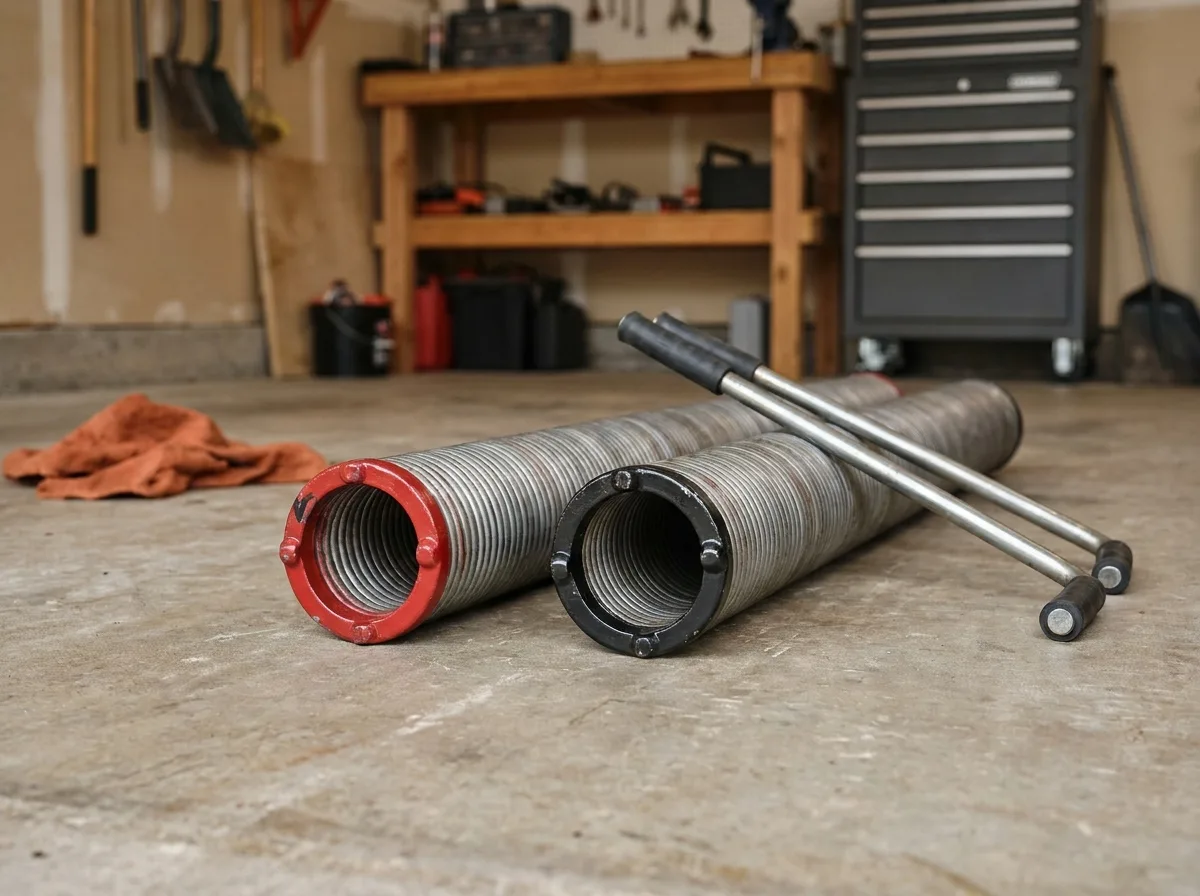
A retailer listing shows how this works. DURA-LIFT, for example, lists wire sizes from .207 to .250 inches, with a 2 inch inside diameter, and 15,000-plus cycle ratings. The listing notes that cycle ratings are based on a 7 foot door, so a taller door may get fewer cycles.
| Spec | What it means | Why it matters |
|---|---|---|
| Wire size | Thickness of the steel wire, such as .207 or .250 inch | Thicker wire lifts more weight |
| Inside diameter | Usually 1.75 or 2 inches | Must fit your shaft |
| Length | Often in the 22 to 33 inch range | Affects turns and lift |
| Wind | Left or right, often red or black coded | Springs come as a mirrored pair |
| Cycle rating | Commonly 10,000 standard, 15,000 or more high cycle | Sets expected lifespan |
How this was judged: rows reflect retail listings and common pro advice, not lab tests. The DASMA data sheet on spring cycle life notes that regular lubrication helps maximize life, and that spring cycle life may not match door cycle life.
What should you do when a garage door spring is broken?
Stop using the door. Pull the red release handle only if the door is fully closed, keep hands and people clear, and call a pro. Don’t run the opener, and don’t try to force the door open. A broken garage door spring means the door’s full weight is no longer balanced.
How do you know it’s broken at all? The usual signs of a garage door spring broken are a loud bang, a visible gap in the coil, a door that rises only a few inches, or slack cables.
Can you open it by hand? Don’t. The door may weigh 130 to 400 pounds, a commonly cited range, and it can drop fast. Call a pro, and know that codes and warranty terms vary.
A common mistake: a homeowner hears the bang, presses the button a few times "to see," and burns out the opener motor on top of the spring bill.
Should you replace one spring or both, and can you do it yourself?
Replace both. Springs on the same door age together, so when one breaks the other is usually close behind, and the labor is the same either way. As for DIY, the majority of pros say hire help, because winding a spring stores enough force to cause serious injury.
Say one spring on a two-spring torsion spring garage door snaps at year eight. Replacing only that one saves maybe $40 to $75 in parts, a reader-reported range. Six months later the second breaks, and the trip charge is paid again. That’s the false economy.
On DIY, readers split. A few report $100 to $168 in parts and about an hour with a video. Many more warn about hands and faces. I’d skip it, because winding takes proper steel winding bars, never screwdrivers.
Safety note: this work involves heavy stored energy. Always use a qualified technician, and remember codes and warranty terms vary by area and by door maker.
How much does torsion spring garage door replacement cost?
Reader-reported prices for a pair, labor included, mostly fall between $275 and $600. The parts themselves are often under $100 each. The rest is labor, trip charge, insurance and warranty. High-cycle springs, bigger doors and emergency calls push the price up.
These are Reddit and Quora anecdotes, not a price survey. Retail spring prices we saw on 2026-11-24 ran from about $8 to $160 at Lowe’s and about $72 to $96 at DURA-LIFT, depending on size and rating.
| Job | Reader-reported range | What drives it |
|---|---|---|
| One spring, standard | A few reader reports, varies widely by region | Region, labor, warranty |
| Pair, standard | About $275 to $600 | Cycle rating, door weight |
| Pair, high cycle | Usually higher than standard, per a few reader reports | Longer rated life |
| TorqueMaster conversion | One reader reported $450 to $850 | Parts, access, door type |
One reader paid $950 and felt gouged, while another paid $275 with a 10 year warranty. The difference is rarely the spring alone. It’s warranty, spring quality and a written quote.
How do you tell a fair quote from a rip-off?
A fair quote is written, itemized and names the spring’s cycle rating, wire size and warranty. Be wary of a phone price that changes on arrival, a rebuild pitched when only springs failed, or a suspiciously low bid, since cheap bidders sometimes use undersized springs.
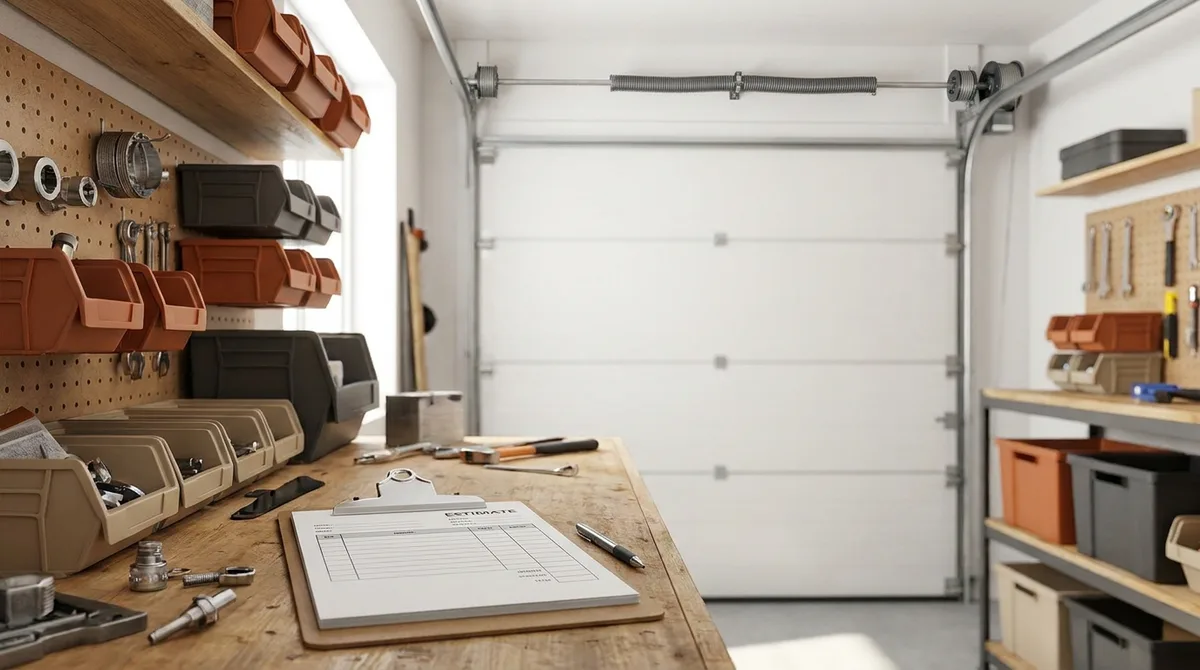
Part of the gap between parts and invoice is real. Trip, insurance and warranty sit inside the price. It becomes a rip-off when details are vague.
Ask before saying yes:
- What cycle rating is the spring, and what are the wire size and length?
- Does the warranty cover parts and labor, or parts only on this torsion spring garage door?
- Is the price for a pair, and is it written down?
One reader got an $1,800 rebuild estimate when techs said springs and bearings alone should land far lower. Get three quotes if you can, even when the car is stuck.
How long does a torsion spring last?
Commonly cited figures are 7 to 12 years, or roughly 10,000 to 15,000 cycles, depending on the rating. Use matters more than age. A door opened six times a day reaches a standard rating far sooner than one used twice. Lubrication and balance also change the outcome.
A family opening the door six times a day does roughly 2,200 cycles a year, so a 10,000 cycle spring could be tired in under five years. That’s simple arithmetic, not a study, but it shows why a high-cycle rating can be worth paying for.
How do you make a torsion spring garage door last longer?
Lubricate the spring on the schedule your door maker gives, using a garage door lubricant, and inspect it twice a year. Fix balance problems early, since a poorly balanced door wears springs faster. Check for rust more often in coastal air.
Nothing makes a torsion spring garage door immortal. But lubrication helps, according to the DASMA data sheet on cycle life.
Should you convert a TorqueMaster system?
A TorqueMaster is the Wayne Dalton design with the spring hidden inside the shaft. Converting to a conventional torsion setup is mostly a repair-access decision rather than a spring decision. It is worth asking about when your system fails, not before.
One reader reported paying $450 to $850 for a conversion. Treat that as a single anecdote. The cost depends on the parts needed, how reachable the shaft is and the door type. A few readers suggest conventional springs are easier to source, so ask your installer which is simpler to service where you live, and get the quote in writing.
Frequently Asked Questions
How do I know what spring I need?
Read the wire size, inside diameter, length and wind direction, then match them to your door’s weight. The old spring’s markings or a label on the door help, but a broken coil can be hard to measure.
Can I open the door manually with a broken spring?
It’s risky, so don’t. Without the spring, the door can feel extremely heavy and may drop suddenly. Leave it closed, keep people clear and call a pro, who will know the safe way to handle it. Codes and warranty terms vary, and never stand under a partly open door.
Will a broken spring damage my opener?
It can. The opener is designed to guide a balanced door, not lift its full weight. Repeated button presses may overheat the motor or strip gears. Quora replies describe this kind of damage. Stop using the opener as soon as you suspect a break, and have the spring checked before the motor takes the blame.
Why did my spring break with no warning?
Springs fatigue from repeated winding, so they often fail at the end of their rated cycles without visible warning. Rust and poor lubrication speed that up. A snapped spring usually means it reached the end of its life, though a technician can check whether imbalance played a part. Ask about that when you book the repair.
Is high-cycle worth it?
For busy households, usually yes. A high-cycle spring is rated for 15,000 cycles or more, instead of the commonly cited 10,000. Families who use the door several times daily reach standard ratings sooner than they expect. It costs more upfront, but replaces less often, which also saves labor.
Can a handyman do it?
Possibly, but ask directly about experience with torsion springs, tools and insurance. A general handyman may not carry the winding bars or warranty a door company offers. A bad winding job is a safety risk, so a specialist is the safer pick. Ask for the warranty terms in writing before work starts.
Should I lubricate the spring and with what?
Yes, lightly, with a lubricant made for garage doors, following your door maker’s schedule. Regular lubrication helps cycle life, according to DASMA. Some homeowners reach for any penetrating spray, which can wash away grease, so check the label. Wipe off excess so dust doesn’t stick.
How often should I inspect the spring?
Look at it twice a year, when the clocks change is an easy reminder. Check for gaps in the coil, rust, frayed cables and a door that no longer balances. Never touch the spring or its fittings while the door is under tension. If anything looks off, photograph it and show the technician.
Can I use one spring on a two-car door?
Some two-car doors run a single spring, but many use two. General pro advice favors two for balance and a backup if one fails. Myth buster: one spring is not always cheaper over time. Ask what your door was built with before changing the setup.
Why do garage companies charge more than the part costs?
The price covers more than the spring. It includes the trip, insurance, same-day availability, tools and warranty. That is not a free pass, though. Insist on an itemized written quote, so you can see what portion is parts and what portion is labor.
Conclusion
The big idea is simple: read the spring before you pay. A torsion spring garage door system isn’t mysterious once you know four numbers and one rule about pairs. Wire size, inside diameter, length and cycle rating tell you what you’re buying, and a written quote tells you what you’re paying for.
Stop the opener, keep your hands clear, call two or three companies, and ask about cycle rating and warranty first.
Your next step: note your spring’s markings today, while nothing is broken.
Want more garage door know-how? Our guides on garage door cable replacement and fixing garage door sensors are good next reads. And if your spring went tomorrow, would you know which questions to ask first?