Spice Rack Organizer: Pick the Style That Fits Your Kitchen

Say you’re halfway through a chili recipe when the recipe says cayenne. You open the cabinet above the stove. Ten jars shift, one tips, and a small avalanche of paprika and oregano lands on the burner you just turned on. You don’t have a cooking problem. You have a storage problem, and a spice rack organizer is the usual answer people reach for.
Most buying advice is a wall of product photos. It never asks how deep your drawer is, where your stove heat travels, or whether you own 20 jars or 120. A rack that looks great online can sit in the wrong spot, hide every label, and turn sticky by spring.
This guide fixes that order of operations. You’ll pick the space first, then the style, then the system that keeps things findable. This is one part of planning a kitchen that works. I’ll also tell you when to skip the rack entirely.
Executive Summary
You can solve spice chaos in an afternoon, and you probably don’t need to spend much. The trick is matching the organizer to the space you actually have, not to the prettiest picture.
Here is what the guide covers:
- Placement beats style. Heat, light and steam from the stove matter more than the finish on the rack.
- Drawers usually win. An angled insert lets you see every lid at once, and IKEA’s Uppdatera is built for Maximera drawers 15 to 36 inches wide and 24 inches deep.
- Magnetic tins suit only a few spices. They look tidy, but many home cooks report spills, rust and clumping.
- Sorting matters as much as the rack. Group by use, cuisine or savory versus sweet, and label the lid so you never dig.
- Sometimes no rack is the right call. A cabinet shelf with a liner can do the job.
The biggest worry is usually "my kitchen is too small." A small kitchen is exactly where a smart choice pays off, and the rental and no-drill options below cover it.
What does a spice rack organizer actually do?
A spice rack organizer holds your jars in a fixed, visible layout so you can find one in seconds without moving others. It does three jobs: it gives each jar a home, it shows the label, and it keeps the collection together. If it fails at any of those three, it’s decoration.
Costs vary with material, size and style. As one reported anecdote, a handmade 36-jar setup cost around $50, while pull-out cabinet units usually cost more depending on the brand. The forms vary a lot. Some sit on the counter, some tuck into drawers, some hang on a door or wall. What they share is a layout that stops jars from drifting. That drift is the real enemy. Jars shift every time you reach, and soon the one you want sits behind four you don’t.
Drawer, cabinet or counter: where should your spices live?
Store spices in a cool, dark, dry spot away from the stove, the oven vent and sunny windows. Heat, light and moisture dull flavor over time. A drawer or closed cabinet nearby usually beats an open counter rack, even though the rack looks nicer on a photo.

I’ll take a firm position here. The rack sitting right beside the burner is the most common mistake. It’s convenient, and it’s also where steam and warmth reach your jars first. Common storage guidance says to avoid heat and light, and I’d treat that as a placement rule, not a style note. No exact shelf-life timelines are given here because they vary by spice.
| Location | Best for | Watch out for |
|---|---|---|
| Drawer near stove | Seeing every lid at once | Tall bottles that hit the top |
| Cabinet shelf or pull-out | Large collections | Jars sliding to the back |
| Cabinet door | Small, daily-use jars | Door weight and hinge strain |
| Open counter | A short list of favorites | Heat, grease and dust |
Which type of spice rack organizer fits your kitchen?
Pick the type by the space you have, not the look you want. Drawers suit shallow, wide storage. Cabinets suit lazy Susans and pull-outs. Walls and doors suit small kitchens with no spare shelf. Counters suit short collections. Measure the space before you click buy.
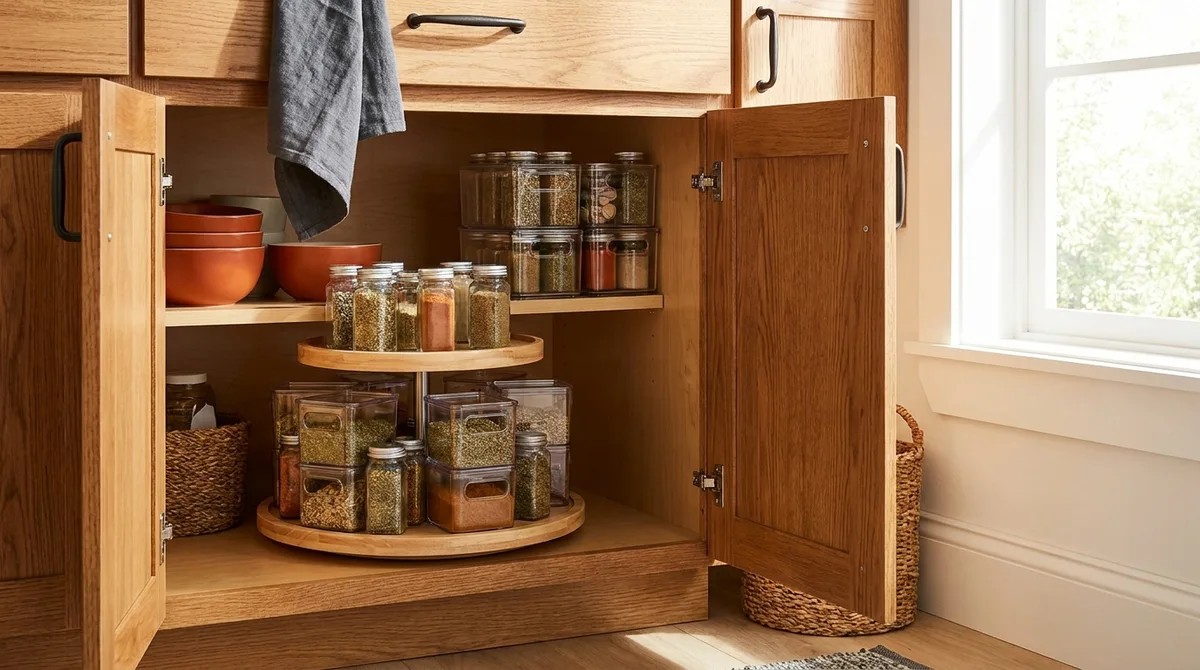
A tiered countertop rack is the classic. It’s easy, but it can hide the back labels, a gripe that keeps coming up in homeowner threads. A lazy Susan (a turntable) works well inside a deep cabinet and lets you group by cuisine. A pull-out cabinet unit beside the stove is the pricey, polished option, and it’s worth it only if you’re already building cabinets.
Stackable bins like the YouCopia SpiceStack pull out whole, and a rolling cart such as IKEA’s Raskog fits a narrow gap. Say a cook has 30 jars and a deep base cabinet. Two stackable acrylic bins can hold the lot, and she lifts out a whole bin to find one jar. That’s a cheap, calm fix that no countertop tower beats.
How do drawer spice organizers work?
A drawer organizer holds jars at an angle or flat in rows so every lid is visible from above. You measure the drawer’s width, depth and height, then choose an insert that fits. The best ones have a non-skid base and leave room for your tallest bottle.
This is where many people win. IKEA lists its Uppdatera insert for Maximera drawers 15, 18, 24, 30 and 36 inches wide, 24 inches deep, with a wipe-clean surface. Check the manufacturer page for your own drawer model before you order.
Measure your tallest bottle first, since lids often hit the drawer top. A narrow stove-side drawer works too. One reported setup fits four jars across and nine deep, with a non-skid liner and labels on both the lid and front. That is 36 jars in one narrow drawer.
Are magnetic spice racks worth it?
Magnetic racks are worth it only for a few daily-use spices on a steel surface you can trust. They save space and look neat, but many users report tins falling, spilling or clumping because the lids aren’t airtight. For a big collection they’re a poor primary system.
The fridge side is a popular spot, and a top Reddit answer with strong votes recommends it. It was also contested in the same thread. The regrets are consistent: tins knocked off by a door swing, sliding lids that rust or clog, and spices that clump since the tins aren’t sealed.
Use magnets as a side shelf for your top five, never the whole system. If you can’t drill, a thin steel plate on 3M strips gives you a magnetic surface without a hole.
How do you mount a wall, door or under-cabinet rack?
Mount a wall rack into studs or with rated anchors, since jars are heavier than they look. Over-the-door and under-cabinet racks need no drilling. Check the weight rating first, and confirm your door or cabinet frame has the clearance for the rack’s depth.
A drilled wall rack needs studs or rated anchors and a level. For a cabinet door, check hinge strain and make sure the rack doesn’t hit the shelf inside. A slim design, under about five inches deep like some 60-jar models, clears most doors. Weight ratings and anchors depend on your wall type, such as drywall, plaster or tile, and renters should check the lease before drilling. Renters can skip holes entirely, and the next section covers them.
How do you choose a spice rack organizer for a small kitchen or rental?
For a small kitchen or rental, choose a no-drill spice rack organizer: an over-the-door rack, a drawer insert, a stackable bin, or a rolling cart. Skip anything that needs holes. Measure the space, then buy the smallest option that still shows every label.

Before you buy a spice rack organizer, measure the space and count your jars. In a rental, lean on options that sit or hang. An over-the-door pantry rack, a cart in a gap, or an insert in an existing drawer all leave no marks. In a very small kitchen the hidden winner is vertical space. A backsplash shelf can hold your top ten jars, with the rest in a drawer. That’s a simple split that many threads recommend, and it keeps counters clear.
How should you organize the spices once the rack is up?
Sort by how you cook, not by the alphabet alone. Put daily spices at eye level, group by cuisine or savory and sweet, and label the lid and the front. Decanting into matching jars is optional. Many cooks scoop from large containers or keep the original bottles.
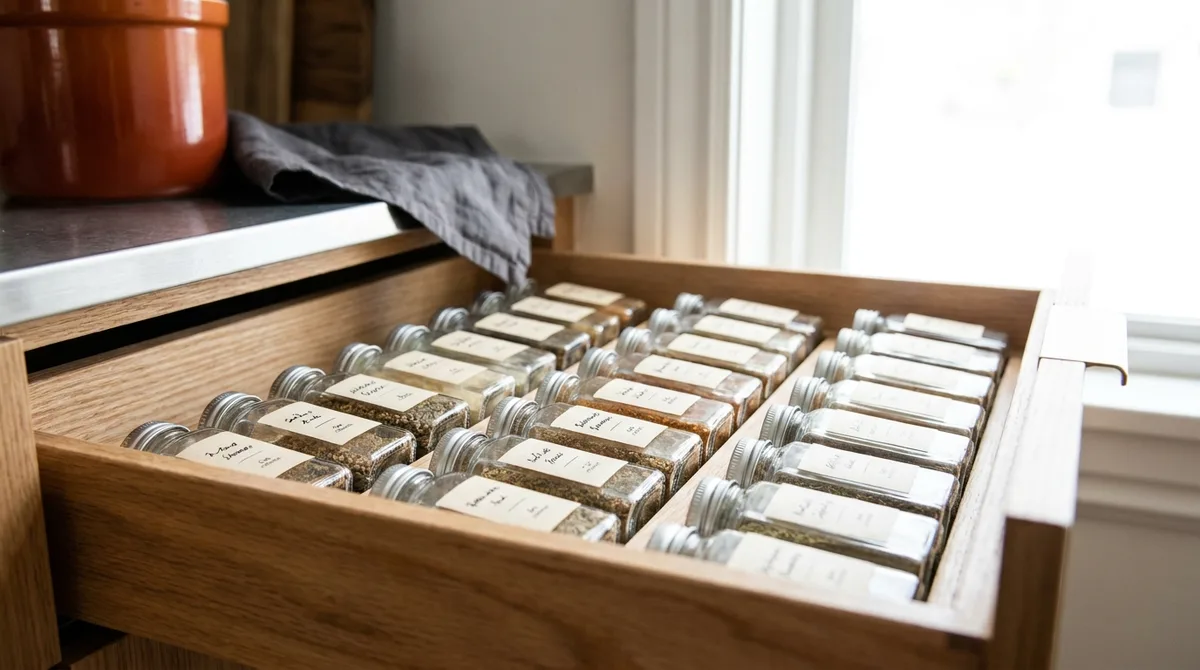
Here’s the myth to retire: you must decant everything. You don’t. Matching jars look lovely and let labels line up, but original bottles work fine and cost nothing. Decant only when it solves a problem, like a bulk refill bag or bottles that won’t fit your drawer.
Labels on both the lid and the side solve the hidden-label problem on tiered racks. And how many spices do you really need? Fewer than the store suggests. Top comments in cook threads say buy as recipes call for them, then size the organizer to your real collection.
What mistakes do people regret with spice racks?
The common regrets are buying before measuring, placing the rack beside the stove, choosing a tiered stand that hides labels, and trusting magnets for the whole collection. Each is cheap to avoid if you check the space, heat and jar height first.
Take a common version of this story. A cook buys a handsome tower, parks it beside the burner, and six months later the lids are sticky and the paprika tastes flat. She moves it to a cabinet door and the problem fades. The spice rack organizer wasn’t bad. The spot was.
When should you skip a spice rack organizer entirely?
Skip the spice rack organizer when you have fewer than about a dozen jars, a deep cabinet that already works, or no spot away from heat. A plain shelf with a non-skid liner and labels often does the job for less money and effort.
Racks are marketing’s favorite answer, but a plain shelf often wins. It’s the same logic as storing vinyl records flat or upright without extra gear. Buy one only when it solves a real problem.
Frequently Asked Questions
Where is the best place to store spices?
Store them in a cool, dark, dry spot, such as a drawer or closed cabinet away from the stove. Heat, light and moisture are the usual culprits behind flat flavor. A drawer near the stove, not above it, gives you quick access without the steam. If counter space is your only option, keep just a few favorites out.
Do spice racks go bad over the stove?
The rack doesn’t, but the spices can lose flavor faster there. Warmth, steam and grease reach jars first when they sit above or beside the burner. Some cooks also report sticky, dusty racks in cooking zones. Move the rack a cabinet or two away, and keep only a few daily spices within reach of the stove.
How many jars should a rack hold?
It should hold your real collection plus some growth room. Many home cooks report anywhere from 30 to over 100 jars, so there’s no fixed number. Count what you own, add some growth room, and then choose a size. Buying spices only as recipes need them keeps the number manageable and the flavors fresher.
Are magnetic spice tins airtight?
Often they aren’t. Many users report clumping, rust on sliding lids and spills. Look for screw-top or gasket lids if you go magnetic, and keep tins for daily-use spices only. Store the rest in sealed jars in a drawer or cabinet where moisture stays low.
Can I hang a spice rack without drilling?
Yes. Adhesive strips such as 3M, over-the-door racks, tension shelves and rolling carts all avoid holes. Check each product’s weight rating, because full jars add up fast. For a magnetic setup, a steel plate on strips works on many smooth walls. Renters get a tidy spice rack organizer this way, with no patching at move-out.
Should I label lids or sides?
Do both if you can. Lid labels help in drawers where you look down. Side or front labels help on shelves and tiered racks where you look straight on. Small stickers cost very little and solve the "which one is cumin" moment. Pick one consistent style so the whole set reads the same.
Do tiered racks hide labels?
Yes, the back rows often hide behind the front ones, a complaint that keeps appearing in homeowner threads. Choose a rack with steep steps, or label the lids too. Another fix is to place your most-used jars in front and keep rarely used ones at the back, so you never need to read them.
How do I fit tall bottles in a drawer organizer?
Measure your tallest bottle against the drawer’s inside height before buying. If it hits the top when angled, lay it flat or move it to a cabinet shelf. Decanting into shorter jars also works. Many cooks keep a few oversize bottles outside the drawer and leave the insert for standard jars.
Is alphabetical or by-use sorting better?
By use usually wins for daily cooking, because your top spices sit in easy reach. Alphabetical works well for shared kitchens, since anyone can find a jar without learning your system. Cuisine groups suit cooks who prepare the same styles often. Choose one and stay consistent, as a mixed system costs more time than it saves.
Do I need to decant my spices?
No, that’s a myth. Original bottles work fine if they fit your storage and you can read the label. Decant only when you buy bulk refills, need matching sizes for a drawer, or want uniform labels. It’s a style choice, not a freshness rule. Skip it if it feels like a chore.
Conclusion
The best spice rack organizer isn’t the prettiest one. It’s the one that fits your drawer, cabinet or wall, stays away from heat and light, and lets you see every label. Start by measuring and counting jars, then pick a style from the table above. If the space already works, you may only need liners and labels.
That’s the quiet lesson of this whole guide. Good storage solves a specific annoyance, such as the paprika avalanche from the opening. It doesn’t just fill a gap.
Your next step is simple: grab a tape measure and a pen, and write down the depth of your best spot. For more storage ideas, see how to store vinyl records without damage or how closet doors that hide clutter work in tight rooms.