
Deck Railing Ideas That Look Good and Pass Inspection

Say you’re standing on your new deck with a railing quote in one hand and a Pinterest board in the other. The board shows sleek black cable and glass panels. The quote says the railing costs more than some of the lumber under your feet. Say a neighbor mentions an inspector can make you tear out a whole run if the gaps are too wide.
Most deck railing ideas online are galleries of finished decks. They show you the look and skip the code, the labor and the way a rail slowly works itself loose.
Here’s the promise. You’ll get every major railing style, what each one really asks of you, and the checks that keep a pretty rail from becoming a failed inspection. This is one piece of building an outdoor space you’ll actually use.
Executive Summary
These deck railing ideas come with a plan. You’ll leave knowing which railing material fits your view, your budget and your tolerance for upkeep. Wood is still the best-value pick when it’s sealed. Composite and aluminum trade a higher price for less maintenance. Cable looks modern, but labor and tension hardware make it a premium pick, not a bargain one. Glass protects a view but demands careful framing, and every option must still meet your local code.
The unusual part is the order. Check code before style, because a railing that fails the 4 inch sphere test is a bad idea no matter how good it looks. You’ll also see how to mix materials to save money, how to compare quotes line by line, and why railings loosen after a few years.
What must deck railing ideas get right before looks?
Any railing idea has to clear code first. A guard is generally required when the deck surface sits more than 30 inches above the ground. The common residential height is at least 36 inches, nothing larger than a 4 inch sphere may pass through the infill, and the top rail must resist a 200 pound push. Your local rules decide.
Those figures come from the International Residential Code as summarized by Decks.com. Some places require 42 inches instead. Call your building department before buying anything.
Here’s the pattern that trips people up. Say a homeowner falls for widely spaced horizontal rails because they look airy. The inspector fails the run, and closer spacing is cheaper to plan than to rebuild.
Test any style you love: can a 4 inch ball slip through any gap, and can you grip the stair handrail? One Reddit homeowner’s custom iron railing reportedly failed on grip size and side-to-side stiffness. Pretty and legal are separate tests.
Which wood deck railing ideas still make sense?
Wood is the best-value railing when you seal it on schedule. Pressure-treated pine is the budget standard and cedar looks richer with similar upkeep. Lowe’s notes that treated wood railings can last 20 years or more with care. The trade-off is time: you’ll wash, stain and seal every few years.

I’ll say it plainly: wood gets dismissed too fast in most railing roundups. A sealed rail costs the least up front and is the easiest to repair. A cracked baluster (the vertical picket) is often a simple swap.
Moisture is wood’s real enemy at the post base, so seal the end grain.
Are composite and aluminum deck railing ideas worth the extra cost?
They’re worth it if you hate maintenance and plan to stay put. Composite and vinyl rails resist rot and rarely need sealing. Aluminum is lightweight, strong and often powder-coated, so it holds color well. Both cost more up front than wood, and neither fixes weak framing underneath.

Brands like Trex and TimberTech sell full systems, with warranties advertised around 30 to 50 years. Treat that as a brand claim, since warranties usually cover product, not installer mistakes.
Here’s a myth worth busting. Composite does not mean the whole structure is maintenance free. The posts still bolt to treated-wood framing, and that framing can rot out of sight.
Some Quora voices say composite looks plastic up close. Aluminum avoids that, though a cheap powder coat can chip.
My pick for most owners staying 10 years or more: aluminum balusters with a composite or wood cap rail. It gives clean lines without the full composite price.
What should you know before choosing cable or glass railings?
Cable and glass keep views open, but both are premium and unforgiving. Cable needs rigid posts and tension hardware to avoid sag and meet the 4 inch gap rule. Glass needs proper framing and, depending on style, thick laminated or tempered panels. Neither is the cheap modern option.

Contrarian take: cable is not the budget way to look modern. The cable is cheap, but threading and tensioning it takes hours of labor, and a Reddit thread on a stair cable quote debated the price for exactly that reason.
For cable, the details decide everything:
- 304 vs 316 stainless. One fabricator said 304 costs roughly two thirds of 316. That’s anecdotal, so verify with your supplier. Near salt water, 316 is the usual choice, since stainless is not stain free.
- Post spacing. Posts too far apart let cable flex, and gaps open up.
Glass is different. It works beautifully when your view lines up with the horizon, and it blocks wind. But a forum commenter in Washington State noted that glass without a top rail needs thick laminated glass, which costs more.
How do you pick a railing for privacy, pets and kids?
Match the railing to who uses the deck. Families with toddlers want tight infill and no climbable horizontal rails. Dog owners want gaps small enough for the smallest pet. Privacy seekers want solid panels, slats or screens. The code gap is the minimum, not the safe choice for every household.
The 4 inch rule exists for small children, but a small dog can still squeeze through. Mesh infill can close that gap and adds little visual weight.
Slatted screens and solid panels block neighbors’ sight lines but also catch wind, so screen only the side facing the neighbor.
For toddlers, pick vertical balusters and skip ladder-style horizontal rails. For wind, solid panels help, but check posts and footings for the extra load.
A picket fence already in your yard? Echo its rhythm in the railing.
Can you mix materials or skip the top rail to save money?
Yes, within code. Mixing materials spends money where you see it most, such as cable or glass in the view section and wood balusters elsewhere. Skipping a top rail is possible with some systems but it removes stiffness, so ask your inspector first.
Say a deck has one long run facing a lake and two short runs facing the driveway. Premium infill on the long run only could cut the pricey material sharply.
One caution: a no-top-rail design relies entirely on the glass or post strength, and some jurisdictions treat that differently. Ask before you buy the glass.
Which deck railing ideas add style, lighting and built-ins?
Style comes from small choices: post caps, rail color, infill pattern, lighting and added features like a drink rail. Match the architecture. Black metal suits modern homes, white painted wood suits cottages, and rustic timber suits cabins. Lighting and built-ins add use and mood without changing the structure.
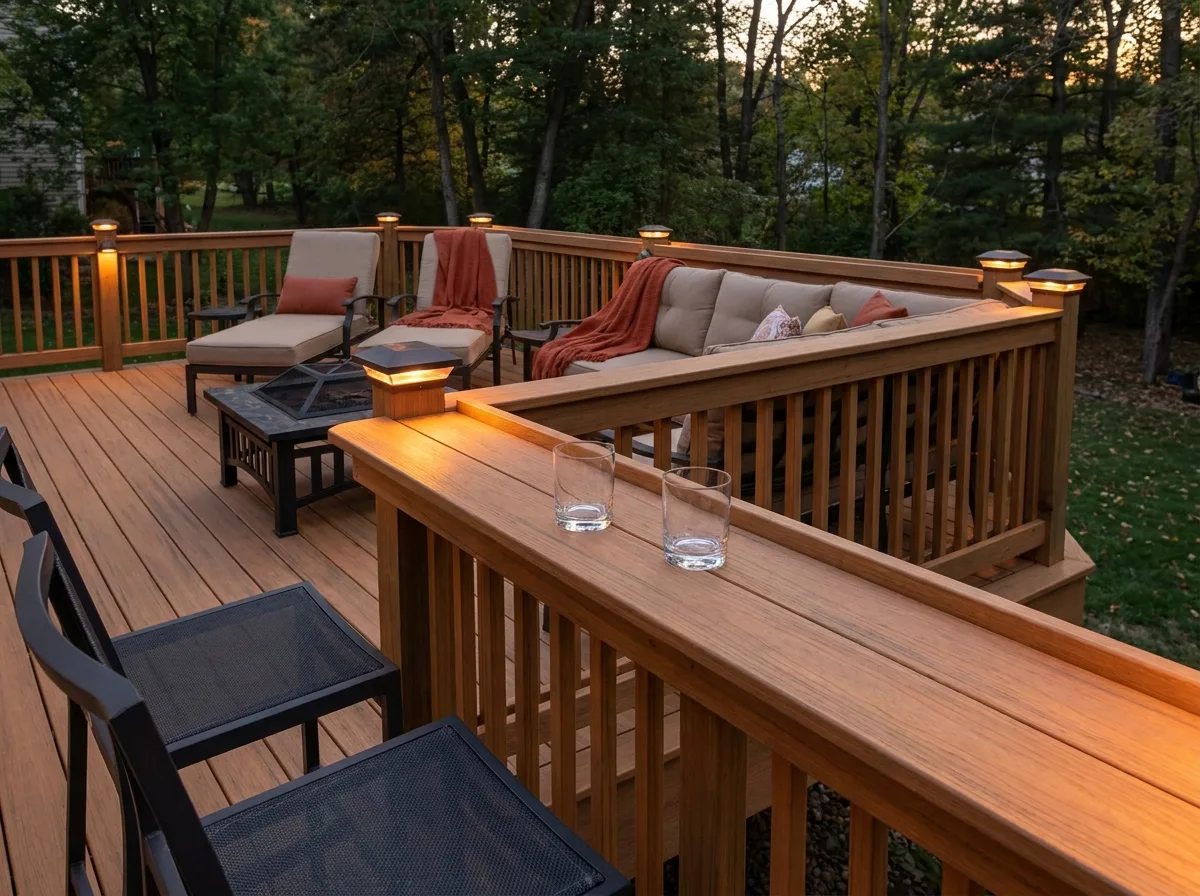
Brands promote styles from coastal to chalet, but you can borrow the logic:
- Coastal: white or light gray, 316 stainless near salt air. Horizontal lines are popular, but skip them if toddlers use the deck, since they can be climbed.
- Industrial: black powder-coated aluminum, thin balusters.
- Traditional: square balusters, turned post caps, painted white.
- Curved: striking, but custom work, so expect higher cost and fewer installers.
A flat drink rail (a wide cap rail where you can set a glass) is the cheapest upgrade I’d actually push for. It turns the railing into furniture.
For lighting, post cap lights, under-rail strips and stair riser lights all work. Low-voltage kits are common for DIY, but any line-voltage wiring needs a licensed electrician and often a permit. Codes vary.
What do deck railings cost installed, and how do you read a quote?
Railing prices vary widely. Cost depends on material, run length, stairs, height, framing repairs and your local labor market. Cable and glass usually land higher than wood or aluminum, mostly because of labor and specialty parts. No reliable national per-foot figure exists, so compare itemized quotes line by line.
I won’t invent a per-foot number. One Reddit thread described a Boston homeowner quoted $4,750 for several short runs, with other bids at $3,800 and $1,350 (labor only), per the poster. The cheapest bid refused to pull permits. That is the real lesson: the lowest number isn’t the same job.
Use this checklist before you sign:
- Is the quote itemized (materials, labor, stairs, demo, permit)?
- Are posts attached with through-bolts or lag screws?
- Who pulls the permit?
- What height and infill spacing will be built?
- How big is the deposit? A commenter’s rule: never pay two thirds up front.
Get three quotes and compare them apples to apples.
Why do railings go loose, and how do you build one that stays tight?
Railings loosen because they work like levers. A person leaning on the top rail multiplies force at the post base, prying fasteners and rotting wood over time. Strong posts, through-bolts, solid blocking and sealed post bases prevent most failures. Loose or wobbly rails are a safety issue, not cosmetic.
Quora contributors call railings "giant levers," and they’re right. A leaning load pries the post away from the frame. Through-bolts with blocking resist better than lag screws.
Another failure: balusters pop out of their sockets after a few years. Reddit threads trace it to a spreading or loose bottom rail. Shims may hold briefly, while threaded-rod fixes were suggested for a lasting repair.
Fasten posts to framing, never to siding alone, and seal every post bottom.
Post attachment is structural. If yours moves under hand pressure, hire a qualified carpenter or deck builder. DIY suits sealing and baluster swaps, but a load-bearing connection isn’t worth the risk. Install quality matters as much as material, so vet who you hire.
Frequently Asked Questions
How high must a deck railing be?
A common residential minimum is 36 inches, and some jurisdictions, including parts of California, require 42 inches. Rules can also differ for stairs and for decks used commercially. Your local building department has the final answer, so call before ordering materials, and measure from the finished deck surface to the top of the rail.
When is a deck railing required?
Guards are generally required when the deck surface is more than 30 inches above the ground below. Your area may set a different threshold, and an inspector can confirm it. If you’re near the line, a railing is still worth considering, since even a modest fall can injure a child or an older relative.
What is the cheapest deck railing?
Pressure-treated wood balusters are usually the lowest cost option, especially when you build them yourself. Costs climb with cable, glass, curved rails and custom metalwork. Cheap only stays cheap when the install meets code, so a bid that skips permits can cost far more later.
Is composite railing worth it?
It’s worth it if you want low upkeep and expect to keep the deck for many years. You pay more up front, and the framing beneath still needs to be sound and treated. Some people dislike how composite looks or feels in strong heat. Compare samples in direct sunlight against aluminum, and ask what the warranty covers.
Does cable railing pass code?
It can, but only when posts are spaced and tensioned so a 4 inch sphere can’t pass between cables, even under load. Cable flexes, so installers need rigid posts and the right tensioning hardware. Ask your inspector about local requirements before you buy any cable kit.
Can I skip the permit for a railing?
No, that’s a myth. Replacing or adding a guard can need a permit, and unpermitted work may have to be torn out, which can cost more than the permit would have. Call your building department, and ask any contractor in writing who is pulling the permit.
How do I fix a wobbly railing?
First find the source: a loose post connection, a spreading rail or a failed baluster socket. Tighten fasteners, or replace lag screws with through-bolts and add blocking behind the post where the framing allows. Shims can steady balusters briefly. If a post moves under hand pressure, stay off that section and call a qualified deck builder.
Does stainless cable rust?
Stainless resists rust but isn’t rust proof. Near salt water, 316 stainless holds up better than 304, though it costs more. A seasonal wash keeps surface staining away, and rinsing helps most near the coast or a pool.
Do I need a top rail with glass?
Not always, and it depends on the system and your local code. Some clamped panels pass without a top rail when the glass is thick laminated or tempered, and others need one for stiffness. A top rail also gives people a handhold. Confirm the requirement with the manufacturer and your inspector before ordering any glass, because custom panels are hard to return.
How long do wood railings last?
Lowe’s says pressure-treated wood railings can last 20 years or more with care. That means regular washing, sealing and replacing rotted parts early. Poor drainage at the post base shortens that life, and cedar behaves similarly.
Conclusion
The best deck railing ideas are the ones that pass inspection first and look good second. Wood wins on value if you’ll maintain it, aluminum and composite win on low upkeep, and cable and glass earn their place when the view is worth the price. Mixing materials turns these deck railing ideas into a look without paying for it on every foot. If you’re weighing custom against a standard kit, one Quora voice noted custom work can help resale, though standard kits are easier to replace.
You can now read both the quote and the Pinterest board. Check your local height and gap rules, request an itemized quote and ask how posts will be attached.
Looking ahead, expect more low-profile infill and integrated lighting in kits that already account for code.
For your next read, see how a fence along the yard edge frames the rest of your yard, or a wire panel fence keeps sight lines open.
So which part of your deck will you protect with the best material, and which part can quietly be the budget version?