Christmas Charcuterie Board Ideas That Work on a Real Holiday Table
Say it’s December 23rd and eight people arrive in two hours. You’ve pinned a gorgeous cheese tree with rosemary "branches," and now you’re staring at a cutting board half the size you need, one pair of tongs, and a brie that’s still ice cold. Most christmas charcuterie board ideas look flawless in a photo and fall apart on an actual table. The cheese sweats, the crackers go soft, and somebody leans over the whole thing to reach a grape.
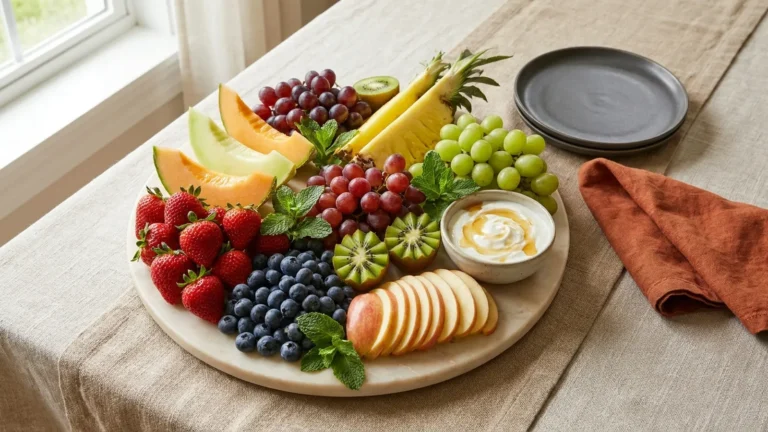
This guide filters the ideas through how they behave when you host. You’ll get board sizes by headcount, a food-safety clock, a make-ahead timeline, and honest notes on which themed boards are worth the effort. It’s one part of home entertaining, and it pairs well with a fruit-forward board with quantities and styling tips if you want a lighter option on the same table.
Executive Summary
You can serve a festive, crowd-pleasing board from these christmas charcuterie board ideas without overspending or wasting half of it. The trick is to plan around your table before you plan around your theme. Start with the board size that matches your guest count, then pick a color palette and one simple shape. Most of the "wow" comes from color and restraint, not from a cookie-cutter novelty.
Here’s what you’ll find below. A size chart for 4, 8 and 12 guests. A classic red, white and green build that needs only a handful of ingredients. A cheese-first approach that is usually easier on the budget than a meat-heavy board. The USDA two-hour rule for how long it can sit out. And a make-ahead timeline that keeps crackers crisp.
The biggest objection is effort. The simpler boards here can come together in roughly 25 minutes once the prep is done, and none needs special equipment beyond a board, a few bowls and a knife for each cheese.
Which christmas charcuterie board ideas are easiest to pull off?
The easiest christmas charcuterie board ideas use a simple palette and a few strong ingredients: a red, white and green board, a baked brie centerpiece, or a cheese-and-fruit wreath. Skip anything that needs precise cutting or an exact silhouette. Fewer items, arranged in clusters, look intentional and give you less to buy, wash and refill.
Beginners reach for the Grinch or Santa hat because those photos travel, but they demand many identical pieces. A baked brie in the middle with cranberries, rosemary and a fan of crackers gets you most of the festive effect in about a third of the work.
The shape isn’t what guests remember. They remember whether the cheese was good and whether they could reach it. Pick the idea that leaves you calm. That is the real test for christmas charcuterie board ideas.
How big should the board be for 4, 8 or 12 guests?
Plan your board by headcount. A small board of about 10 by 14 inches suits 4 guests, a medium one of about 12 by 18 inches suits 8, and for 12 or more consider two boards. A second board also fixes the single-tongs problem.

These sizes are my rule-of-thumb ranges, not a standard, and they assume an appetizer. If the board is the meal, add roughly half.
| Guests | Board size (approx.) | Cheeses | Cured meats | Extras |
|---|---|---|---|---|
| 4 | 10 x 14 in | 2 | 1 to 2 | 1 jam, 1 pickle, 1 fruit |
| 8 | 12 x 18 in | 3 | 2 to 3 | 2 spreads, 2 pickles, 2 fruits |
| 12 | Two boards | 4 | 3 | Doubled, split by board |
Two boards beat one giant board for a simple reason. People cluster in a crowd, and a single large board makes a traffic jam at one corner. Put one near the drinks and one near the seating, and the flow sorts itself out.
What goes on a classic red, white and green board?
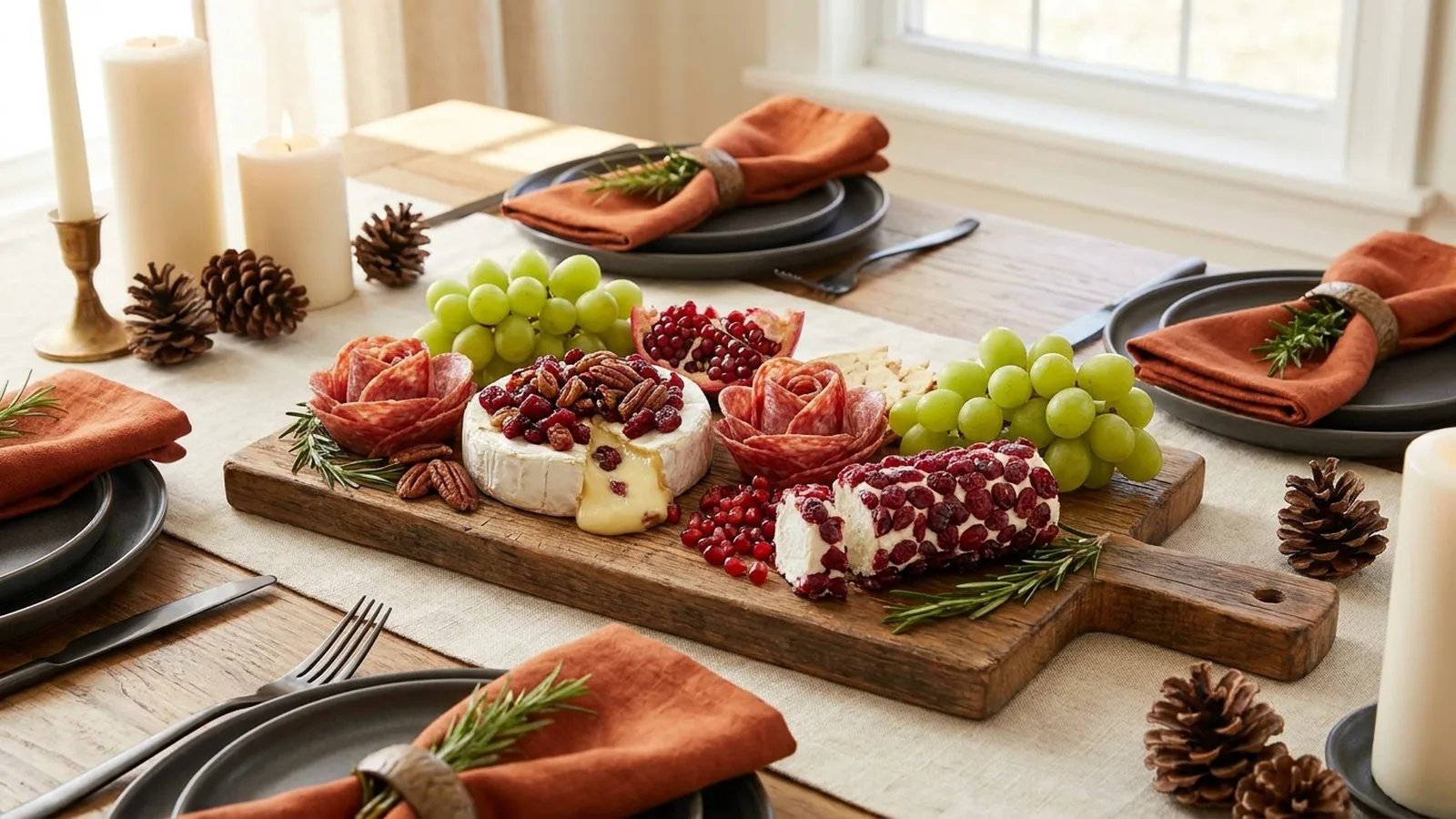
A classic Christmas charcuterie board uses red cranberries, pomegranate seeds and salami, white brie and goat cheese, and green grapes, rosemary and olives. Build it in layers: cheeses and bowls first, then meats folded in clusters, then fruit and crackers in the gaps. Keep crackers in a separate basket so they stay crisp.

Think of it as a color plan, not a recipe, and treat this classic christmas charcuterie board as the base for every variation. Cured meats such as salami, prosciutto and soppressata bring the red, while a goat cheese log rolled in dried cranberries gives you a ready-made ornament. Aged cheddar and manchego add depth if you want something firm to balance the soft cheese.
Most home boards miss one thing: you need acid and sweetness. Cornichons, olives or pickled onion cut through the fat. Fig jam, honey or pepper jelly gives the cheese a partner. A board with ten kinds of cheese and nothing sharp tastes flat by the third bite.
Quick assembly order that takes about 25 minutes:
- Place bowls and the cheeses, with a knife for each.
- Fold the meats into loose ribbons or a salami "river."
- Fill gaps with grapes, clementines and pomegranate seeds.
- Tuck in rosemary sprigs last, so they stay green.
Which christmas charcuterie board ideas are worth the shaped-board effort?
Shaped boards such as the Christmas tree, wreath or star are worth the effort when you want a centerpiece and have 30 to 45 minutes. A tree uses rows of cheese cubes and rosemary, and a wreath uses a ring of cheese and fruit around a bowl of dip. Otherwise skip them. Novelty shapes cost more and waste more.

A tree board is a triangle of cheese cubes and crackers topped with a cookie-cutter star and rosemary sprigs. A wreath works on a round board with a baked brie in the center, ringed with grapes, cranberries and herbs.
Say a host builds a tree board for eight and ends up with half the cheese cubes left, because those cubes were cut to fit the shape, not to be eaten. That’s the honest trade-off with shapes. You trim for the picture, and the trimmings become waste.
My opinion: do one shape and keep everything else plain. Three novelty boards look like a craft table.
How do you build a cheese-first board, and is it still charcuterie?
A cheese-first board puts three or four cheeses at the center and uses just one or two cured meats as supporting players. Strictly speaking it’s a cheese board, because charcuterie means cured meats. That’s fine. A cheese-first board is usually easier on the budget, since cheese is often cheaper per serving than a spread of meats. It also feels less crowded and is easier to adapt for guests who skip meat.
Online threads about christmas charcuterie board ideas tend to split into two camps. Purists point out that charcuterie is simply cured meats, and everyone else just wants a good snack platter. Both are right. If you want a name that dodges the argument, call it a holiday grazing board.
For the cheese itself, pick by texture instead of by name: one soft (brie or burrata), one firm aged (cheddar, gouda or manchego), and one with attitude (blue). One reader tip worth stealing: open only some of the cheeses at a time, and let the board feature the cheese instead of seven useless garnishes.
Where should the board go, and how long can it sit out?
Set the board where guests can reach it from two sides, away from the oven and the entry, with a spare surface for plates. According to the USDA, perishable food shouldn’t sit out more than 2 hours, or 1 hour when it’s above 90 degrees F. Refill small amounts from the fridge instead of leaving everything out.
The danger zone, as the USDA defines it, runs from 40 to 140 degrees F. Set a phone timer when the board goes out.
What serveware keeps a shared board tidy?
Give every cheese its own knife, so flavors don’t cross over. Add small spoons for jams and pickles, and a second pair of tongs for the meats. The running joke about hosts owning one pair of tongs has a practical side too: shared utensils that touch everything make a board messier and less pleasant to eat from.
Not sure where to start with single-serve? Layered charcuterie cups for portion control sidestep the shared-board worry entirely.
How far ahead can you make it, and how do you keep it affordable?
Prep your christmas charcuterie board components the day before and assemble 30 to 60 minutes before guests arrive. Cut hard cheese, wash fruit and portion nuts the night before, then cover everything loosely and refrigerate. Pull cheese out about 30 minutes before serving so it tastes better. Budget by buying fewer, better items and skipping novelty shapes.
A sensible timeline looks like this. The day before: slice firm cheeses, make any dips, and shop. Morning of: wash and dry fruit, fill ramekins. One hour before: assemble the board and keep it covered in the fridge. Thirty minutes before: take it out and add the crackers last.
On cost, a charcuterie board is rarely cheap because you buy many small items. The way to control it is to cut the count. A cheese-first approach, one cured meat, seasonal fruit like clementines and grapes, and a cheap sweet-salty pairing such as honey and nuts will cost less than five meats and six cheeses. Prices vary by store and region, so I won’t quote a dollar figure.
What are the best kid, dessert and vegan christmas charcuterie board ideas?
For kids, build a board of cheese cubes, pretzel "ornaments," grapes and mini sandwiches. For dessert, use cookies, chocolate, candy canes and fruit, or a hot chocolate board with marshmallows. For vegan guests, swap in hummus, roasted vegetables, nuts and plant-based cheese on a separate small board.
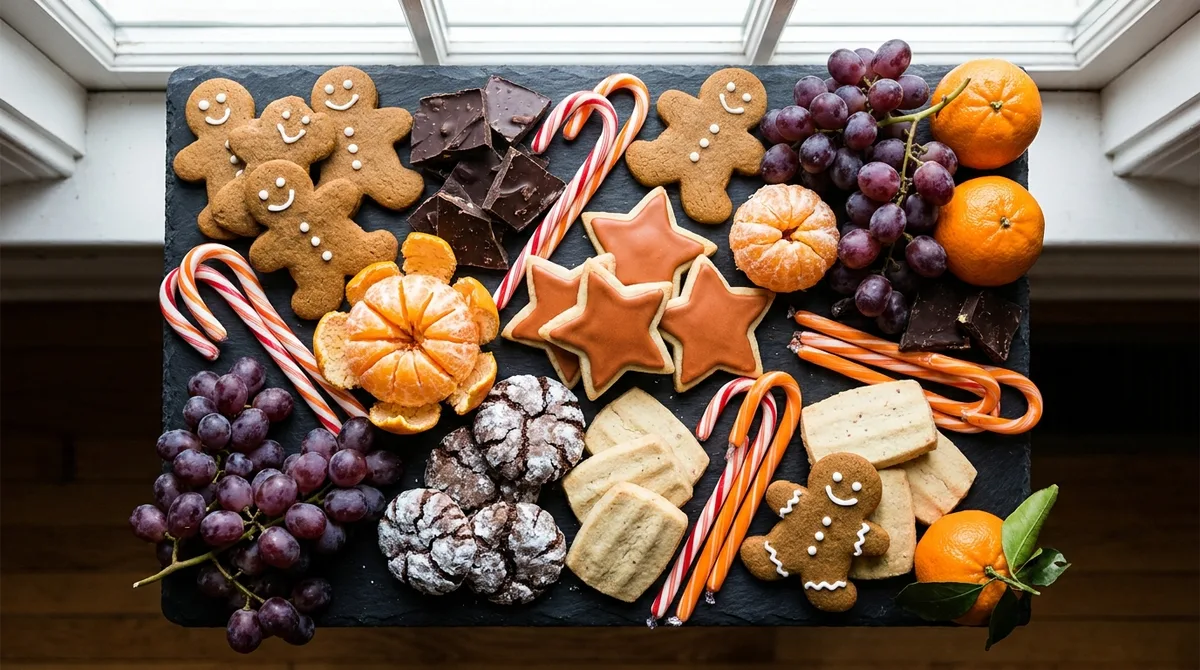
Kids’ boards work best with finger-sized pieces. A dessert board is a good second board next to the savory one, and a hot chocolate board with toppings turns into an activity.
Say a host has four kids under ten coming to a December afternoon party. A tray of cheese stars cut with a cookie cutter, pretzel "ornaments," grapes cut in half and a small bowl of mini marshmallows for hot chocolate keeps them busy. The adults’ board stays intact, because the kids have their own at a low table. A common version of this mistake is to put one board in the middle and watch it get picked apart in five minutes.
For vegan, vegetarian and gluten-free guests, make a small separate board instead of pushing items to the edge of the main one. That avoids cross-contact with meat, and it saves you from the worry of whether the cracker is gluten-free. A spiced nut mix and a jar of olives travel well on either board. Fall, Easter or breakfast boards follow the same structure, so change the palette only.
Frequently Asked Questions
How much food do I need per person?
Plan a couple of ounces of cheese and a smaller portion of cured meat per guest as an appetizer, plus a handful of crackers and fruit. Amounts vary widely with the crowd and the rest of the menu, and these are rule-of-thumb figures, not an official standard. If the board replaces dinner, increase everything by about half. When in doubt, buy more cheese than meat, because cheese keeps better in the fridge.
Can I make a Christmas charcuterie board the night before?
Yes, partly. Prep the components the night before: cut firm cheeses, wash fruit, fill ramekins and cover everything. Assemble the board an hour before guests arrive and add crackers last so they stay crisp. Don’t assemble a fully built board hours in advance, because fruit weeps and soft cheese dries at the edges. Single-serve cups are easier to prep ahead.
How do I store leftovers?
Wrap cheeses and meats separately, store them airtight in the fridge, and eat within three to four days, which is the window Kath Eats gives. Anything that sat out longer than two hours should go in the trash, not the fridge. Toss soft fruit that has been sitting in juices, and keep crackers in their own bag.
What cheeses work best on a holiday board?
Choose by texture: a soft cheese like brie, a firm aged one like cheddar, gouda or manchego, and one bold choice such as blue. Three cheeses are plenty for most gatherings. Add a goat cheese log rolled in cranberries if you want an easy festive touch.
Can I use a plate instead of a board?
Yes. Any flat, food-safe surface works, including a sheet pan lined with parchment, a large platter or a marble slab. The board is not the point. What matters is that it holds your ingredients without crowding and that guests can reach them from two sides.
Is a board with only cheese still a charcuterie board?
Technically no. Charcuterie means cured meats, so a cheese-only board is a cheese board. Most people use the words interchangeably at parties, and nobody checks. If you want to be accurate, call it a holiday grazing board or cheese board. Neither name changes how good it tastes.
How many cheeses and meats are enough?
Three cheeses and two cured meats are plenty for up to eight guests. More choices just mean more waste and a higher bill, and the extra items rarely get touched. Start with the smaller count, then add one fruit or one spread if the table still looks bare. That is the safest way to scale any of these christmas charcuterie board ideas up or down.
What can I serve for kids?
Keep it simple: cheese cubes, grapes, pretzels, mini sandwiches and a few cookies. Cut round foods like grapes in half for young children. Cookie cutters turn bread and cheese into stars and trees in seconds, and mini pretzels make easy ornaments. Fruit skewers are an easy win. Set their plate at a low table or the end of the buffet, away from the knives.
What if a guest is vegan?
Build a small separate board with hummus, roasted vegetables, olives, nuts, fruit and gluten-free crackers if needed. A separate board avoids cross-contact and spares your guest the awkward moment of asking what is safe. Label it clearly, give it its own utensils, and keep it on the same table so nobody feels sidelined.
What drinks go with a Christmas charcuterie board?
Sparkling wine is a safe choice because bubbles cut through rich cheese. A fruity red or a crisp white also works. For nonalcoholic options, try sparkling cider or cranberry spritzers. Pick one or two drinks and stop there, because a long drink list is just another thing to stock and chill. Match the drink to the richest item on the board, usually the cheese, and keep water within easy reach.
Conclusion
The best christmas charcuterie board ideas aren’t the ones with the cleverest shapes. They’re the ones that fit your table, your guest list and your clock. Size the board by headcount, put acid and sweetness next to the cheese, keep the 2-hour rule in mind, and prep the night before so you can enjoy your own party.
If I had to pick one change, it would be going cheese-first. It’s usually easier on the budget, wastes less and flexes for most diets.
Your next step is simple: count your guests, choose one board size from the chart, and write your shopping list tonight. For more ideas, try a quantity-and-styling guide to fruit boards or make-ahead charcuterie cups for the overflow crowd. So, which will you build first: the tidy cheese-first board or the tree that everyone will photograph?